Solved

Passage The Bicarbonate (HCO3) Buffer System (Reaction 1) Helps to Maintain

Question 9

Multiple Choice

Passage
The bicarbonate (HCO3) buffer system (Reaction 1) helps to maintain acid-base homeostasis and a blood pH near 7.4.  Therefore, concentrations of carbon dioxide (CO2) and HCO3 must be tightly regulated through adaptations in respiratory and renal physiology.  For patients with suspected acid-base imbalance, these concentrations can be monitored by blood gas analysis performed on arterial or venous blood.

Passage The bicarbonate (HCO<sub>3</sub><sup>−</sup>)  buffer system (Reaction 1)  helps to maintain acid-base homeostasis and a blood pH near 7.4.  Therefore, concentrations of carbon dioxide (CO<sub>2</sub>)  and HCO<sub>3</sub><sup>−</sup> must be tightly regulated through adaptations in respiratory and renal physiology.  For patients with suspected acid-base imbalance, these concentrations can be monitored by blood gas analysis performed on arterial or venous blood.    CO2g+H2Ol⇔carbonic anhydraseH2CO3aq⇔pKa=6.35HCO3-aq+H+aq<strong>Reaction 1</strong>In most automated blood gas analyzers, ionized hydrogen, CO<sub>2</sub>, and oxygen (O<sub>2</sub>)  in the sample diffuse through semipermeable membranes and are measured at separate electrodes (Figure 1) .  The pH-sensitive glass electrode (E1)  is separated from the blood sample by a membrane permeable to hydrogen ions. The sample pH is determined according to the voltage difference between E1 and a reference electrode maintained in a solution of standard pH.  CO<sub>2</sub> diffuses across a gas-permeable membrane to E2, where it reacts to generate HCO<sub>3</sub><sup>−</sup> and free hydrogen ions.  In a modification of the mechanism used in E1, partial pressure of CO<sub>2</sub> (PaCO<sub>2</sub>)  is calculated indirectly from the change in pH, as determined by the potential difference between E2 and its reference electrode.E3, also called the Clark electrode, is an electrochemical cell containing a silver anode and a platinum cathode.  O<sub>2</sub> diffuses through another gas-permeable membrane and reacts with hydrogen ions to form water.  The current measured at E3 is then used to calculate PaO<sub>2</sub> in the blood sample.    <strong>Figure 1</strong>  Automated blood gas analyzerThe concentration of carbonic acid (H<sub>2</sub>CO<sub>3</sub>) , reported in milliequivalents per liter (mEq/L) , can be calculated from PaCO<sub>2</sub> by Equation 1:    H2CO3mEqL=0.03×PaCO2mm Hg<strong>Equation 1</strong>Subsequently, using the concentration of H<sub>2</sub>CO<sub>3</sub> obtained from Equation 1, the HCO<sub>3</sub><sup>−</sup> concentration resulting from decomposition of carbonic acid can then be calculated by applying the Henderson-Hasselbalch equation. -If a 0.2-mL blood sample with a PaCO<sub>2</sub> of 40 mm Hg diffuses across a membrane into the E2 electrode containing 0.3 mL of solution, the final PaCO<sub>2</sub> in the blood sample will be: A) exactly 0 mm Hg. B) less than 16 mm Hg. C) exactly 16 mm Hg. D) greater than 16 mm Hg. CO2g+H2Ol⇔carbonic anhydraseH2CO3aq⇔pKa=6.35HCO3-aq+H+aqReaction 1In most automated blood gas analyzers, ionized hydrogen, CO2, and oxygen (O2) in the sample diffuse through semipermeable membranes and are measured at separate electrodes (Figure 1) .  The pH-sensitive glass electrode (E1) is separated from the blood sample by a membrane permeable to hydrogen ions. The sample pH is determined according to the voltage difference between E1 and a reference electrode maintained in a solution of standard pH.  CO2 diffuses across a gas-permeable membrane to E2, where it reacts to generate HCO3 and free hydrogen ions.  In a modification of the mechanism used in E1, partial pressure of CO2 (PaCO2) is calculated indirectly from the change in pH, as determined by the potential difference between E2 and its reference electrode.E3, also called the Clark electrode, is an electrochemical cell containing a silver anode and a platinum cathode.  O2 diffuses through another gas-permeable membrane and reacts with hydrogen ions to form water.  The current measured at E3 is then used to calculate PaO2 in the blood sample.
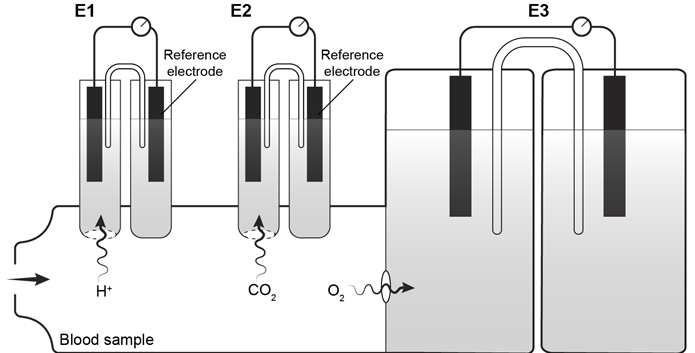
Passage The bicarbonate (HCO<sub>3</sub><sup>−</sup>)  buffer system (Reaction 1)  helps to maintain acid-base homeostasis and a blood pH near 7.4.  Therefore, concentrations of carbon dioxide (CO<sub>2</sub>)  and HCO<sub>3</sub><sup>−</sup> must be tightly regulated through adaptations in respiratory and renal physiology.  For patients with suspected acid-base imbalance, these concentrations can be monitored by blood gas analysis performed on arterial or venous blood.    CO2g+H2Ol⇔carbonic anhydraseH2CO3aq⇔pKa=6.35HCO3-aq+H+aq<strong>Reaction 1</strong>In most automated blood gas analyzers, ionized hydrogen, CO<sub>2</sub>, and oxygen (O<sub>2</sub>)  in the sample diffuse through semipermeable membranes and are measured at separate electrodes (Figure 1) .  The pH-sensitive glass electrode (E1)  is separated from the blood sample by a membrane permeable to hydrogen ions. The sample pH is determined according to the voltage difference between E1 and a reference electrode maintained in a solution of standard pH.  CO<sub>2</sub> diffuses across a gas-permeable membrane to E2, where it reacts to generate HCO<sub>3</sub><sup>−</sup> and free hydrogen ions.  In a modification of the mechanism used in E1, partial pressure of CO<sub>2</sub> (PaCO<sub>2</sub>)  is calculated indirectly from the change in pH, as determined by the potential difference between E2 and its reference electrode.E3, also called the Clark electrode, is an electrochemical cell containing a silver anode and a platinum cathode.  O<sub>2</sub> diffuses through another gas-permeable membrane and reacts with hydrogen ions to form water.  The current measured at E3 is then used to calculate PaO<sub>2</sub> in the blood sample.    <strong>Figure 1</strong>  Automated blood gas analyzerThe concentration of carbonic acid (H<sub>2</sub>CO<sub>3</sub>) , reported in milliequivalents per liter (mEq/L) , can be calculated from PaCO<sub>2</sub> by Equation 1:    H2CO3mEqL=0.03×PaCO2mm Hg<strong>Equation 1</strong>Subsequently, using the concentration of H<sub>2</sub>CO<sub>3</sub> obtained from Equation 1, the HCO<sub>3</sub><sup>−</sup> concentration resulting from decomposition of carbonic acid can then be calculated by applying the Henderson-Hasselbalch equation. -If a 0.2-mL blood sample with a PaCO<sub>2</sub> of 40 mm Hg diffuses across a membrane into the E2 electrode containing 0.3 mL of solution, the final PaCO<sub>2</sub> in the blood sample will be: A) exactly 0 mm Hg. B) less than 16 mm Hg. C) exactly 16 mm Hg. D) greater than 16 mm Hg. Figure 1  Automated blood gas analyzerThe concentration of carbonic acid (H2CO3) , reported in milliequivalents per liter (mEq/L) , can be calculated from PaCO2 by Equation 1:

Passage The bicarbonate (HCO<sub>3</sub><sup>−</sup>)  buffer system (Reaction 1)  helps to maintain acid-base homeostasis and a blood pH near 7.4.  Therefore, concentrations of carbon dioxide (CO<sub>2</sub>)  and HCO<sub>3</sub><sup>−</sup> must be tightly regulated through adaptations in respiratory and renal physiology.  For patients with suspected acid-base imbalance, these concentrations can be monitored by blood gas analysis performed on arterial or venous blood.    CO2g+H2Ol⇔carbonic anhydraseH2CO3aq⇔pKa=6.35HCO3-aq+H+aq<strong>Reaction 1</strong>In most automated blood gas analyzers, ionized hydrogen, CO<sub>2</sub>, and oxygen (O<sub>2</sub>)  in the sample diffuse through semipermeable membranes and are measured at separate electrodes (Figure 1) .  The pH-sensitive glass electrode (E1)  is separated from the blood sample by a membrane permeable to hydrogen ions. The sample pH is determined according to the voltage difference between E1 and a reference electrode maintained in a solution of standard pH.  CO<sub>2</sub> diffuses across a gas-permeable membrane to E2, where it reacts to generate HCO<sub>3</sub><sup>−</sup> and free hydrogen ions.  In a modification of the mechanism used in E1, partial pressure of CO<sub>2</sub> (PaCO<sub>2</sub>)  is calculated indirectly from the change in pH, as determined by the potential difference between E2 and its reference electrode.E3, also called the Clark electrode, is an electrochemical cell containing a silver anode and a platinum cathode.  O<sub>2</sub> diffuses through another gas-permeable membrane and reacts with hydrogen ions to form water.  The current measured at E3 is then used to calculate PaO<sub>2</sub> in the blood sample.    <strong>Figure 1</strong>  Automated blood gas analyzerThe concentration of carbonic acid (H<sub>2</sub>CO<sub>3</sub>) , reported in milliequivalents per liter (mEq/L) , can be calculated from PaCO<sub>2</sub> by Equation 1:    H2CO3mEqL=0.03×PaCO2mm Hg<strong>Equation 1</strong>Subsequently, using the concentration of H<sub>2</sub>CO<sub>3</sub> obtained from Equation 1, the HCO<sub>3</sub><sup>−</sup> concentration resulting from decomposition of carbonic acid can then be calculated by applying the Henderson-Hasselbalch equation. -If a 0.2-mL blood sample with a PaCO<sub>2</sub> of 40 mm Hg diffuses across a membrane into the E2 electrode containing 0.3 mL of solution, the final PaCO<sub>2</sub> in the blood sample will be: A) exactly 0 mm Hg. B) less than 16 mm Hg. C) exactly 16 mm Hg. D) greater than 16 mm Hg. H2CO3mEqL=0.03×PaCO2mm HgEquation 1Subsequently, using the concentration of H2CO3 obtained from Equation 1, the HCO3 concentration resulting from decomposition of carbonic acid can then be calculated by applying the Henderson-Hasselbalch equation.
-If a 0.2-mL blood sample with a PaCO2 of 40 mm Hg diffuses across a membrane into the E2 electrode containing 0.3 mL of solution, the final PaCO2 in the blood sample will be:


A) exactly 0 mm Hg.
B) less than 16 mm Hg.
C) exactly 16 mm Hg.
D) greater than 16 mm Hg.

Correct Answer:

verifed

Verified

Unlock this answer now
Get Access to more Verified Answers free of charge

Related Questions

Unlock this Answer For Free Now!

View this answer and more for free by performing one of the following actions

qr-code

Scan the QR code to install the App and get 2 free unlocks

upload documents

Unlock quizzes for free by uploading documents