A 26-year-old woman is being evaluated for a possible inherited disorder. She has a 6-year history of generalized tonic-clonic seizures, and a year ago, she had partial loss of vision due to an occipital infarction. Her mother has chronic intermittent muscle weakness and lactic acidosis, and her maternal uncle has hemiplegia. Skeletal muscle biopsy of the patient shows ragged-appearing muscle fibers. After further evaluation, all the affected family members are found to suffer from the same inherited disease. Pedigree analysis is shown in the image below. 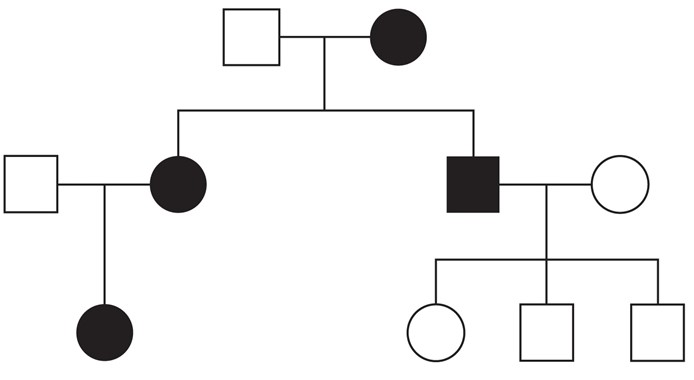 Which of the following is the most likely explanation for the variability of clinical manifestations in the affected family members?
A) Anticipation
B) Heteroplasmy
C) Incomplete penetrance
D) Mosaicism
E) Uniparental disomy
Correct Answer:

Verified
Q50: An infant born to a 26-year-old woman
Q51: An infant born to a 26-year-old woman
Q52: A 4-year-old boy is brought to the
Q53: A pharmaceutical researcher develops a therapy to
Q54: A 60-year-old man comes to the office
Q56: A 9-year-old boy is brought to the
Q57: A non-coding DNA sequence mutation is thought
Q58: A healthy 31-year-old woman arrives to the
Q59: A 20-year-old man falls while strolling across
Q60: On physical examination, a 1-day-old child in
Unlock this Answer For Free Now!
View this answer and more for free by performing one of the following actions

Scan the QR code to install the App and get 2 free unlocks

Unlock quizzes for free by uploading documents