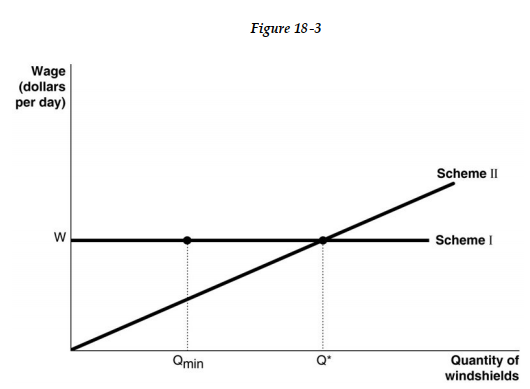
 Figure 18-3 shows two different compensation schemes for the Youness Corporation, an installer of auto glass windshields. Under Scheme I, the firm pays a consistent daily wage of $80 per day based on an 8-hour workday. QMin in represents the cut-off point under the hourly-wage system: if a worker installed fewer than QMin in windshields, the worker got fired. Scheme II represents a piece-rate scheme with an earnings floor: no worker would get less than $80 per day (for an 8-hour workday) and would have to produce at least QMin in. For any output level beyond Q* the worker earned an additional $20 for each unit produced.
-Refer to Figure 18 -3. Under Scheme I,
A) workers compete with each other to see who can produce beyond QMin in the shortest possible time.
B) the incentive to increase productivity depends on where QMin is set; if it is at a very high level, then workers will rise to the challenge for fear of losing their jobs.
C) workers signal their productivity to the firm by consistently producing above QMin.
D) workers have no incentive to produce beyond QMin.
Correct Answer:

Verified
Q16: One of the important challenges in the
Q17: Scenario 18-1: In academia, professors in some
Q18: Scenario 18-1: In academia, professors in some
Q19: Compensating wage differentials compensate workers for some
Q20: Wage differences in the labor market are
Q21: Paying unionized workers higher wages than non
Q22: Which of the following statements about commission

Unlock this Answer For Free Now!
View this answer and more for free by performing one of the following actions

Scan the QR code to install the App and get 2 free unlocks

Unlock quizzes for free by uploading documents