A 75-year-old man with a history of Parkinson disease, bipolar disorder, and hypertension is brought to the emergency department with confusion and fever. His caregivers report that last week he complained of stomach cramps and diarrhea and stopped taking his medications as he thought they were worsening his symptoms. His medications include carbidopa/levodopa, sertraline, lithium, lisinopril, and amlodipine. He does not use tobacco or illicit drugs but drinks 2 or 3 beers on weekends.
On evaluation, the patient is diaphoretic and confused. Temperature is 38.3 C (101 F) , blood pressure is 180/95 mm Hg, pulse is 114/min, and respirations are 20/min. The mucous membranes are dry. He has prominent generalized muscular rigidity and bilateral tremor. The abdomen is nontender and bowel sounds are present.
Laboratory results are as follows: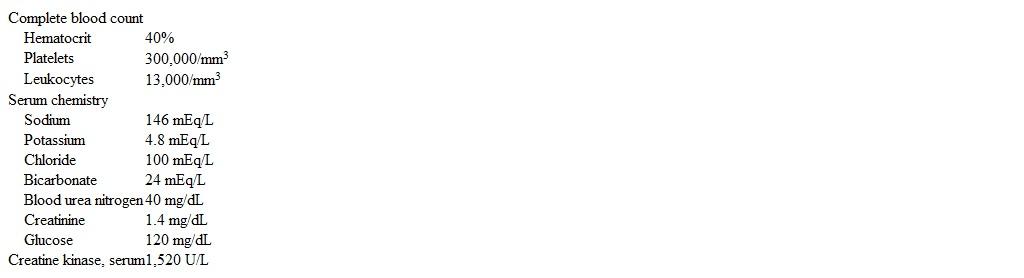 ECG shows sinus tachycardia and nonspecific T-wave changes. Spinal fluid evaluation shows no abnormalities. Which of the following is the most likely diagnosis?
A) Lithium toxicity
B) Malignant hyperthermia
C) Neuroleptic malignant syndrome
D) On-off phenomenon
E) Serotonin syndrome
Correct Answer:

Verified
Q169: A 20-year-old woman is brought to the
Q170: A 76-year-old man is brought to the
Q171: A 28-year-old woman is brought to the
Q172: A 72-year-old woman comes to the emergency
Q173: A 65-year-old man with a history of
Q175: A 65-year-old woman comes to the emergency
Q176: A 66-year-old woman is brought to the
Q177: A 36-year-old woman comes to the emergency
Q178: A 54-year-old man comes to the emergency
Q179: A 65-year-old woman comes to the emergency
Unlock this Answer For Free Now!
View this answer and more for free by performing one of the following actions

Scan the QR code to install the App and get 2 free unlocks

Unlock quizzes for free by uploading documents