A 79-year-old nursing home resident is admitted to the hospital for nausea, vomiting, and abdominal distension. He has had little oral intake over the last 48 hours. This morning, workers at his facility noticed that his abdomen was distended. The patient's medical history is remarkable for advanced dementia, coronary artery disease, hypertension, cerebrovascular accident, atrial fibrillation with rapid ventricular response, chronic low back pain, and gastroesophageal reflux disease. Medications include aspirin, furosemide, hydrocodone with acetaminophen, metoprolol, calcium, vitamin D, simvastatin, and omeprazole. He was hospitalized for a myocardial infarction 3 months ago.
The patient's temperature is 36.7 C (98 F) , blood pressure is 131/78 mm Hg, pulse is 98/min, and respirations are 18/min. Pulse oximetry shows an oxygen saturation of 98% on room air. BMI is 22 kg/m2. Lungs are clear to auscultation. The abdomen is distended and nontender. Bowel sounds are present with increased tympany to percussion throughout.
Laboratory results are as follows: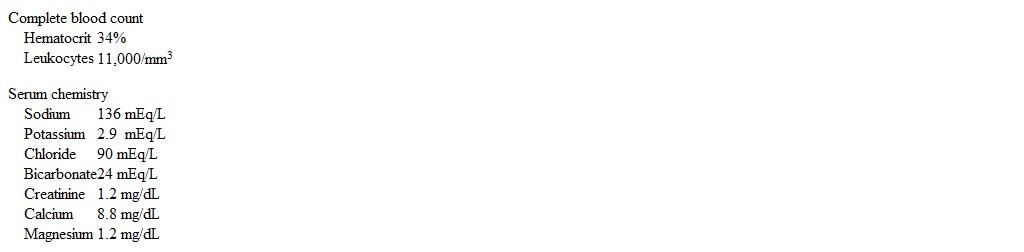 Abdominal radiograph reveals marked dilation of the cecum, right hemicolon, and transverse colon with a maximal colonic diameter of 11.3 cm. Abdominal CT scan confirms colonic dilation with no evidence of mechanical obstruction or bowel wall thickening.
Intravenous fluids are administered along with potassium and magnesium supplementation.
Which of the following is the best initial management for this patient?
A) Intravenous metoclopramide
B) Intravenous neostigmine
C) Percutaneous tube cecostomy
D) Serial abdominal examinations
E) Subcutaneous methylnaltrexone
Correct Answer:

Verified
Q30: A 78-year-old man is evaluated for gallstones.
Q31: A 24-year-old African American man complains of
Q32: A 64-year-old man hospitalized with acute myocardial
Q33: A 29-year-old woman undergoes thyroidectomy for Graves'
Q34: A 44-year-old woman is brought to the
Q36: A 23-year-old woman with a 12-year history
Q37: An 80-year-old man is hospitalized because of
Q38: A 60-year-old man with alcoholism is admitted
Q39: An 88-year-old nursing home resident is admitted
Q40: A 66-year-old woman is admitted to the
Unlock this Answer For Free Now!
View this answer and more for free by performing one of the following actions

Scan the QR code to install the App and get 2 free unlocks

Unlock quizzes for free by uploading documents