Solved

A 52-Year-Old Woman Comes to the Office Due to Fatigue

Question 249

Multiple Choice

A 52-year-old woman comes to the office due to fatigue and mild weight loss.  For the last several weeks, she has also experienced hot flashes, heat intolerance, and trouble sleeping.  The patient has had no tremors, palpitations, neck pain, proximal weakness, eye discomfort, diplopia, or swelling.  Her medical history is notable for hypertension treated with metoprolol and hydrochlorothiazide.  Family history is positive for hypertension and osteoporosis in her mother.  The patient does not use tobacco or alcohol.  She experienced natural menopause at age 50.
Vital signs are normal.  Ocular examination shows mild lid lag without proptosis.  Neck examination reveals a 2.5-cm nodule in the right lobe of the thyroid gland without surrounding lymphadenopathy.  There are no tremors or pretibial myxedema.  The remainder of the examination is normal.
Laboratory results are as follows:

A 52-year-old woman comes to the office due to fatigue and mild weight loss.  For the last several weeks, she has also experienced hot flashes, heat intolerance, and trouble sleeping.  The patient has had no tremors, palpitations, neck pain, proximal weakness, eye discomfort, diplopia, or swelling.  Her medical history is notable for hypertension treated with metoprolol and hydrochlorothiazide.  Family history is positive for hypertension and osteoporosis in her mother.  The patient does not use tobacco or alcohol.  She experienced natural menopause at age 50. Vital signs are normal.  Ocular examination shows mild lid lag without proptosis.  Neck examination reveals a 2.5-cm nodule in the right lobe of the thyroid gland without surrounding lymphadenopathy.  There are no tremors or pretibial myxedema.  The remainder of the examination is normal. Laboratory results are as follows:   Thyroid ultrasound shows a 2.5-cm solitary thyroid nodule in the right lobe.  Radioactive iodine uptake scan (shown in the image)  at 24 hours is 30% (normal: 10%-30%) , predominantly in the nodule with minimal surrounding uptake.   Beta blocker therapy is initiated to reduce the patient's symptoms.  Which of the following additional interventions is the most appropriate management for this patient's condition? A) Fine-needle aspiration of the right thyroid nodule B) Long-term methimazole therapy C) Prednisone administration D) Radioactive iodine ablation E) Reassurance and repeat thyroid function in 6 weeks Thyroid ultrasound shows a 2.5-cm solitary thyroid nodule in the right lobe.  Radioactive iodine uptake scan (shown in the image) at 24 hours is 30% (normal: 10%-30%) , predominantly in the nodule with minimal surrounding uptake.
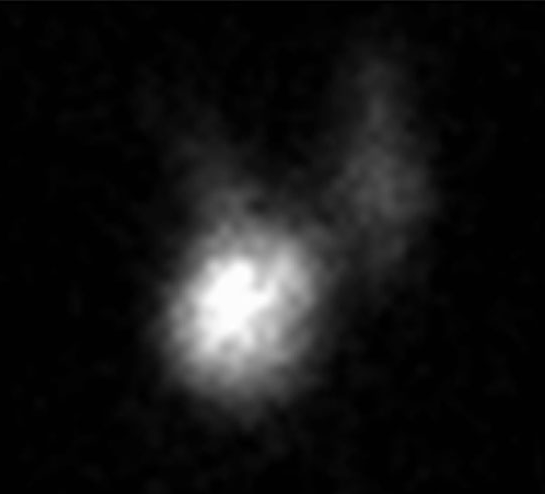
A 52-year-old woman comes to the office due to fatigue and mild weight loss.  For the last several weeks, she has also experienced hot flashes, heat intolerance, and trouble sleeping.  The patient has had no tremors, palpitations, neck pain, proximal weakness, eye discomfort, diplopia, or swelling.  Her medical history is notable for hypertension treated with metoprolol and hydrochlorothiazide.  Family history is positive for hypertension and osteoporosis in her mother.  The patient does not use tobacco or alcohol.  She experienced natural menopause at age 50. Vital signs are normal.  Ocular examination shows mild lid lag without proptosis.  Neck examination reveals a 2.5-cm nodule in the right lobe of the thyroid gland without surrounding lymphadenopathy.  There are no tremors or pretibial myxedema.  The remainder of the examination is normal. Laboratory results are as follows:   Thyroid ultrasound shows a 2.5-cm solitary thyroid nodule in the right lobe.  Radioactive iodine uptake scan (shown in the image)  at 24 hours is 30% (normal: 10%-30%) , predominantly in the nodule with minimal surrounding uptake.   Beta blocker therapy is initiated to reduce the patient's symptoms.  Which of the following additional interventions is the most appropriate management for this patient's condition? A) Fine-needle aspiration of the right thyroid nodule B) Long-term methimazole therapy C) Prednisone administration D) Radioactive iodine ablation E) Reassurance and repeat thyroid function in 6 weeks
Beta blocker therapy is initiated to reduce the patient's symptoms.  Which of the following additional interventions is the most appropriate management for this patient's condition?


A) Fine-needle aspiration of the right thyroid nodule
B) Long-term methimazole therapy
C) Prednisone administration
D) Radioactive iodine ablation
E) Reassurance and repeat thyroid function in 6 weeks

Correct Answer:

verifed

Verified

Unlock this answer now
Get Access to more Verified Answers free of charge

Related Questions

Unlock this Answer For Free Now!

View this answer and more for free by performing one of the following actions

qr-code

Scan the QR code to install the App and get 2 free unlocks

upload documents

Unlock quizzes for free by uploading documents