A 64-year-old man comes to the physician with malaise and decreased exercise tolerance for the last 2-3 months. He has no abdominal pain, melena, or hematochezia. His weight and appetite have been stable. The patient's past medical history is significant for hypertension, type 2 diabetes mellitus, hypercholesterolemia, and osteoarthritis. His medications include lisinopril, metformin, pravastatin, and naproxen as needed for knee pain. He does not use tobacco, alcohol, or illicit drugs.
The patient's vital signs are stable. Physical examination shows mild pallor and a systolic murmur at the right upper sternal border. Digital rectal examination reveals brown stool that tests positive for occult blood.
Laboratory results are as follows: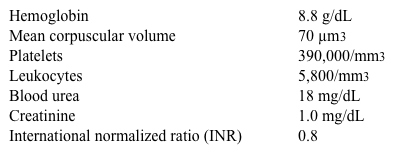
Upper gastrointestinal endoscopy shows a small hiatal hernia. Antral and duodenal biopsies are unremarkable. Colonoscopy performed up to the last 5 cm of the terminal ileum shows small sigmoid diverticula but is otherwise unremarkable.
Which of the following is the most appropriate next step in management of this patient?
A) Meckel's scan
B) Radiolabeled red blood cell scan
C) Serum tissue transglutaminase antibodies
D) Small bowel enteroclysis
E) Wireless capsule endoscopy
Correct Answer:

Verified
Q350: A 62-year-old man comes to the emergency
Q351: A 52-year-old woman is evaluated for a
Q352: A 26-year-old man comes to the office
Q353: A 46-year-old woman was instructed to follow
Q354: A 35-year-old woman comes to the office
Q356: A 35-year-old woman comes to the office
Q357: A 45-year-old man is evaluated for abnormal
Q358: A 58-year-old woman comes to the office
Q359: A 41-year-old man comes to the office
Q360: An asymptomatic 52-year-old man is evaluated for
Unlock this Answer For Free Now!
View this answer and more for free by performing one of the following actions

Scan the QR code to install the App and get 2 free unlocks

Unlock quizzes for free by uploading documents