A 46-year-old woman was instructed to follow up with her primary care physician after a recent emergency department visit for self-limited nausea and vomiting. The patient currently has no issues. Her medical history is notable for obesity, ulcerative colitis, essential hypertension, and gastroesophageal reflux disease. The patient's last ulcerative colitis flare was 5 years ago and was treated with a short course of corticosteroids. Colonoscopy with biopsy performed a year ago revealed mild inflammation with no dysplasia. Her medications include mesalamine, omeprazole, and lisinopril.
Blood pressure is 140/88 mm Hg, pulse is 84/min, and respirations are 14/min. BMI is 32 kg/m2. Cardiopulmonary examination is normal. The abdomen is soft and nontender. There is no hepatomegaly or splenomegaly.
Laboratory results from the patient's recent emergency department visit are as follows: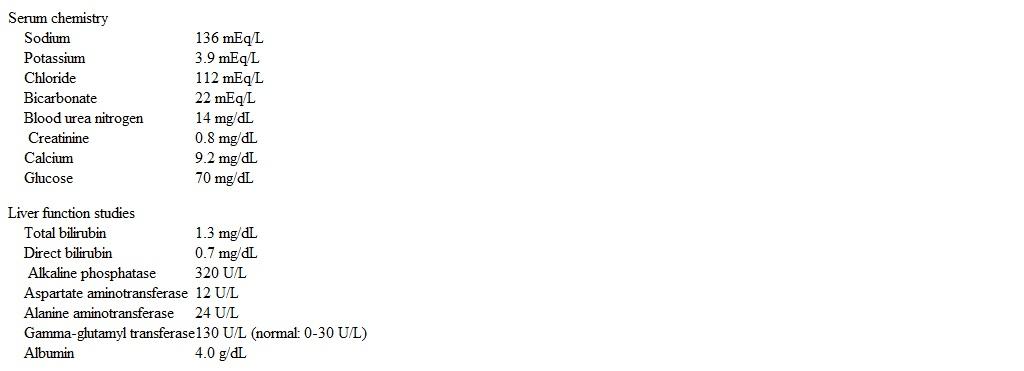 Repeat testing shows similar results.
Which of the following would be the most helpful for establishing the diagnosis in this patient?
A) Bone scan
B) Cholangiography
C) CT scan of the abdomen with contrast
D) Liver biopsy
E) Mesalamine discontinuation
Correct Answer:

Verified
Q348: A 52-year-old man comes to the physician
Q349: A 58-year-old man comes to the office
Q350: A 62-year-old man comes to the emergency
Q351: A 52-year-old woman is evaluated for a
Q352: A 26-year-old man comes to the office
Q354: A 35-year-old woman comes to the office
Q355: A 64-year-old man comes to the physician
Q356: A 35-year-old woman comes to the office
Q357: A 45-year-old man is evaluated for abnormal
Q358: A 58-year-old woman comes to the office
Unlock this Answer For Free Now!
View this answer and more for free by performing one of the following actions

Scan the QR code to install the App and get 2 free unlocks

Unlock quizzes for free by uploading documents