A 58-year-old man comes to the office due to progressive generalized weakness, leg swelling, and abdominal distension for the past several months. The patient also notes that his previously small umbilical hernia has recently enlarged, and he would like it repaired. He has no abdominal pain, hematemesis, or melena. His other medical conditions include type 2 diabetes mellitus, hypercholesterolemia, hypertension, obesity, and nonalcoholic steatohepatitis. He does not use tobacco, alcohol, or illicit drugs.
Blood pressure is 102/76 mm Hg, pulse is 74/min, and respirations are 16/min. The abdomen is moderately distended with fluid wave but nontender. There is a large, reducible, umbilical hernia with expansile cough impulse. There are no dilated superficial veins on the abdominal wall. Rectal examination reveals a normal-sized, nontender prostate gland and occult blood-negative brown stool. There is 2+ bilateral lower extremity pitting edema.
Laboratory results are as follows: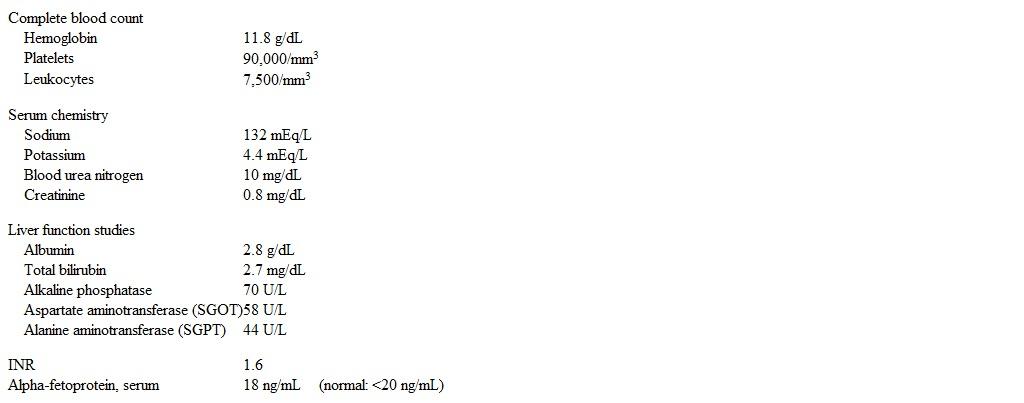 Ultrasonography of the abdomen shows moderate ascites, splenomegaly, and a shrunken liver with no focal masses. Ascitic fluid analysis reveals a leukocyte count of 440/mm3 with 20% neutrophils, protein of 1.8 g/dL, and albumin of 1.2 g/dL. Ascitic fluid culture is pending.
In addition to dietary salt restriction and diuretic therapy, which of the following is the most appropriate next step in management of this patient?
A) Fluoroquinolone prophylactic therapy
B) Nonselective beta blocker therapy
C) Referral for surgical hernia repair
D) Triple-phase CT scan of the abdomen
E) Upper gastrointestinal endoscopy
Correct Answer:

Verified
Q344: A 62-year-old man comes to the physician
Q345: A 37-year-old man comes to the clinic
Q346: A 35-year-old man is evaluated for heartburn
Q347: A 58-year-old woman comes to the office
Q348: A 52-year-old man comes to the physician
Q350: A 62-year-old man comes to the emergency
Q351: A 52-year-old woman is evaluated for a
Q352: A 26-year-old man comes to the office
Q353: A 46-year-old woman was instructed to follow
Q354: A 35-year-old woman comes to the office
Unlock this Answer For Free Now!
View this answer and more for free by performing one of the following actions

Scan the QR code to install the App and get 2 free unlocks

Unlock quizzes for free by uploading documents