A 23-year-old African American man with sickle cell disease (Hb SS disease) comes to the clinic for follow-up. He was admitted to the hospital 2 weeks ago due to headaches, slurred speech, and right-sided arm weakness. Imaging studies of the brain revealed no evidence of hemorrhage. The patient received an exchange transfusion, and his symptoms markedly improved. He was discharged home after 5 days of supportive care. Current medications include folate, acetaminophen, oxycodone, and a multivitamin.
Blood pressure is 123/77 mm Hg and pulse is 82/min. Oxygen saturation is 99% on room air. The lungs are clear to auscultation. A 2/6 systolic murmur is heard at the left upper sternal border. Muscle strength is 4/5 in the right arm and 5/5 in the left arm. The rest of the neurological examination, including speech and coordination, is within normal limits.
Laboratory results are as follows: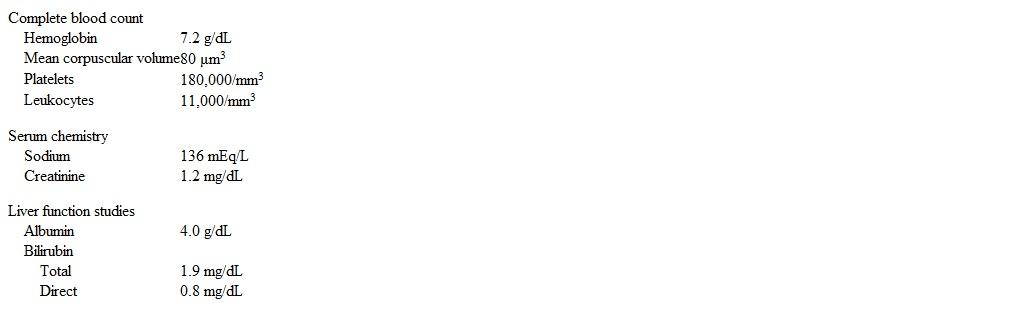 Baseline hemoglobin is approximately 6.9 g/dL. Chest x-ray is clear.
Which of the following is the best strategy to prevent further similar events in this patient?
A) Aspirin therapy
B) Chronic simple transfusion therapy
C) Intermittent exchange transfusions
D) Nimodipine
E) Rivaroxaban therapy
Correct Answer:

Verified
Q423: A 32-year-old woman complains of the sensation
Q424: A 35-year-old woman comes to the physician
Q425: A 67-year-old man with polycythemia vera comes
Q426: A 68-year-old woman is seen in the
Q427: A 37-year-old woman with known systemic lupus
Q429: A 57-year-old man comes to the physician
Q430: A 66-year-old woman with a 10-year-history of
Q431: A 58-year-old woman comes to the walk-in
Q432: A 75-year-old man recently diagnosed with advanced
Q433: A 28-year-old Asian woman comes to the
Unlock this Answer For Free Now!
View this answer and more for free by performing one of the following actions

Scan the QR code to install the App and get 2 free unlocks

Unlock quizzes for free by uploading documents