A 64-year-old woman comes to the emergency department with a 3-day history of intermittent fever, cough with blood-tinged sputum, night sweats, and generalized malaise. She also reports right-sided chest pain on deep inspiration over the last 24 hours. The patient was diagnosed with breast cancer and is undergoing combination chemotherapy. Her other medical problems include moderate chronic obstructive pulmonary disease and hypothyroidism.
Her temperature is 38.2 C (100.8 F) , blood pressure is 107/64 mm Hg, pulse is 110/min, and respirations are 18/min. Pulse oximetry is 93% on room air. Physical examination is notable for pale conjunctiva. Lung examination shows scattered rhonchi, and cardiac examination is significant for tachycardia without murmurs. The abdomen is soft and nontender without organomegaly. There are no skin rashes.
Laboratory results are as follows: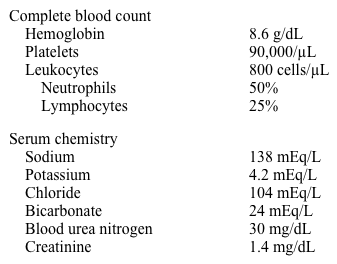
The patient is started on vancomycin and piperacillin/tazobactam and fails to improve clinically after 3 days of treatment. Computed tomography scan of the chest shows several small (1-2 cm) nodular lesions scattered throughout the lung with surrounding ground-glass attenuation.
Blood and sputum cultures are negative, and bronchoscopy and bronchoalveolar lavage are performed for cultures and cytology.
Which of the following is the best next step in management of this patient?
A) Amphotericin B
B) High-dose intravenous corticosteroids
C) Isoniazid, rifampin, ethambutol, and pyrazinamide
D) Linezolid
E) Voriconazole
Correct Answer:

Verified
Q483: A 47-year-old previously healthy man comes to
Q484: A 78-year-old woman comes to the urgent
Q485: A 37-year-old man comes to the physician
Q486: A 27-year-old woman comes to the outpatient
Q487: A 22-year-old man living in Connecticut comes
Q489: A 34-year-old immigrant from Brazil comes to
Q490: A 24-year-old woman is being evaluated for
Q491: A 40-year-old man comes to the physician
Q492: A 29-year-old man comes to the office
Q493: A 36-year-old woman comes to the physician
Unlock this Answer For Free Now!
View this answer and more for free by performing one of the following actions

Scan the QR code to install the App and get 2 free unlocks

Unlock quizzes for free by uploading documents