A 67-year-old man comes to the physician with hematuria. Three days ago, he experienced an episode of gross hematuria that resolved spontaneously. There was no associated dysuria, fever, chills, or flank pain. He did not pass any blood clots in his urine. He denies bleeding or bruising elsewhere except for very rare oozing from the gums after brushing his teeth. The patient has no history of kidney stones or recent trauma. He awakens twice at night to urinate and has noticed a decrease in the size and force of his urine stream over the past 2 years.
His past medical history is significant for hypertension, hyperlipidemia, and coronary artery disease. He underwent placement of 2 drug-eluting coronary artery stents after a non-ST elevation myocardial infarction 3 months ago. His current medications include low-dose aspirin, clopidogrel, lisinopril, metoprolol, and rosuvastatin.
Physical examination is unremarkable.
Laboratory results are as follows: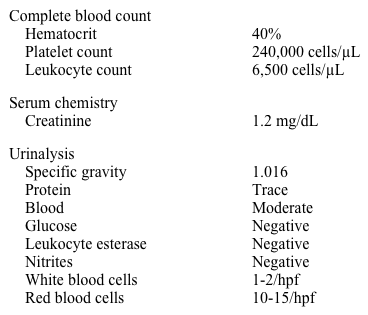
Urine culture is negative.
What is the best next step in the management of this patient?
A) CT urography followed by cystoscopy
B) Discontinue aspirin and clopidogrel
C) Discontinue clopidogrel
D) Obtain coagulation studies
E) Reassurance and repeat urinalysis in 2 weeks
Correct Answer:

Verified
Q781: A 64-year-old man comes to the office
Q782: A 73-year-old woman comes to the clinic
Q783: A 75-year-old man comes for follow-up 6
Q784: A 32-year-old woman comes to the physician
Q785: A 55-year-old man comes to the emergency
Q787: A 52-year-old man comes to the physician
Q788: A 67-year-old man comes to the office
Q789: A 56-year-old man comes to the physician
Q790: A 52-year-old woman comes to the physician
Q791: A 38-year-old woman comes to the office
Unlock this Answer For Free Now!
View this answer and more for free by performing one of the following actions

Scan the QR code to install the App and get 2 free unlocks

Unlock quizzes for free by uploading documents