A 52-year-old man comes to the physician for follow-up on cadaveric renal transplantation done 10 months ago for polycystic kidney disease. His postoperative course was complicated by 2 episodes of acute rejection and an episode of lower gastrointestinal bleeding. These events prompted revision of his immunosuppressive regimen, which now includes prednisone, tacrolimus, mycophenolate, and acyclovir. The patient has no new symptoms. His only other medical problem is diet-controlled type 2 diabetes mellitus.
His blood pressure is 122/70 mm Hg and pulse is 78/min. His BMI is 29 kg/m2. There are no skin rashes. The spleen tip is not palpable. There is no lymphadenopathy.
Laboratory results are as follows: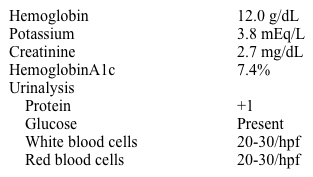
Urine sediment analysis shows cellular casts. Cytology demonstrates atypical cells with intranuclear inclusions.
Which of the following is the most likely diagnosis?
A) Chronic allograft nephropathy
B) Diabetic nephropathy
C) Epstein-Barr virus infection
D) Polyomavirus-induced nephropathy
E) Tacrolimus nephropathy
Correct Answer:

Verified
Q782: A 73-year-old woman comes to the clinic
Q783: A 75-year-old man comes for follow-up 6
Q784: A 32-year-old woman comes to the physician
Q785: A 55-year-old man comes to the emergency
Q786: A 67-year-old man comes to the physician
Q788: A 67-year-old man comes to the office
Q789: A 56-year-old man comes to the physician
Q790: A 52-year-old woman comes to the physician
Q791: A 38-year-old woman comes to the office
Q792: A 43-year-old man undergoes abdominal ultrasonography for
Unlock this Answer For Free Now!
View this answer and more for free by performing one of the following actions

Scan the QR code to install the App and get 2 free unlocks

Unlock quizzes for free by uploading documents