A 36-year-old man comes to the office due to frequent "loose stools" for the past 10 months. The patient describes stools that are large in volume, liquid to semisolid, occurring up to 3-4 times a day, and often foul-smelling. He also reports excessive flatulence and occasional nausea and abdominal cramping. The patient says he may have lost some weight because his clothes are much looser than before. He has no prior medical problems and takes no medications. Family history is notable for hypertension and coronary artery disease in his father. The patient immigrated to the United States from Italy with his family when he was 2 years old and has not traveled out of the country since then. He does not use tobacco or illicit drugs and drinks alcohol occasionally. The patient works in a family-owned restaurant and has had no sick contacts. He consumes a balanced diet and notes no specific association of diarrhea to food. The patient has been in a monogamous relationship with his wife for the past 10 years. Temperature is 36.6 C (97.9 F) , blood pressure is 130/86 mm Hg, and pulse is 72/min. Weight is 63.5 kg (140 lb) . The sclerae are anicteric, and mucous membranes are moist without any lesions. Cardiopulmonary examination is unremarkable. The abdomen is soft, nondistended, and nontender, with no organomegaly. Bowel sounds are increased. Rectal examination shows no masses or tenderness and an empty rectal vault. Stool occult blood testing is negative. Samples for blood count, erythrocyte sedimentation rate, TSH, and serum electrolytes are obtained. The patient comes for a follow-up visit 2 weeks later. He continues to have large-volume, foul-smelling stools but has had no new symptoms. The patient recollects that his weight was about 75 kg (165 lb) prior to the onset of symptoms, and he has lost more than 5 kg (11 lb) . Physical examination findings are unchanged. Laboratory testing performed during the previous visit is notable for the following: 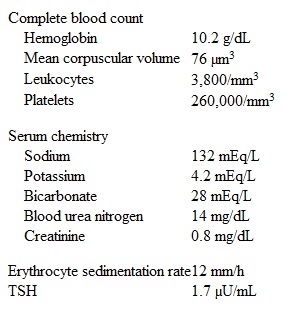 Stool studies revealed a high osmotic gap. Further laboratory studies are ordered. Gastrointestinal endoscopy with biopsy is most likely to reveal which of the following?
A) Colonic subepithelial collagen deposition
B) High bacterial growth in jejunal aspirate culture
C) Normal mucosal architecture with no inflammation
D) Transmural inflammation with lymphocytic infiltration
E) Villus atrophy with increased intraepithelial lymphocytes
Correct Answer:

Verified
Q346: An 11-year-old girl is brought to the
Q347: A 65-year-old postmenopausal woman comes to the
Q348: A 52-year-old man is being evaluated due
Q349: A 36-year-old man comes to the office
Q350: A 30-year-old Caucasian female presents to your
Q352: A 30-year-old Caucasian female presents to your
Q353: A 65-year-old man is brought to the
Q354: A 42-year-old woman with a history of
Q355: A 7-year-old girl is brought to the
Q356: A 45-year-old man comes to the office
Unlock this Answer For Free Now!
View this answer and more for free by performing one of the following actions

Scan the QR code to install the App and get 2 free unlocks

Unlock quizzes for free by uploading documents