Solved

A 45-Year-Old Woman Comes to the Emergency Department Due to Worsening

Question 494

Multiple Choice

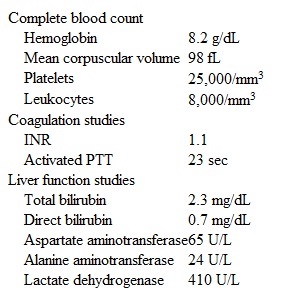
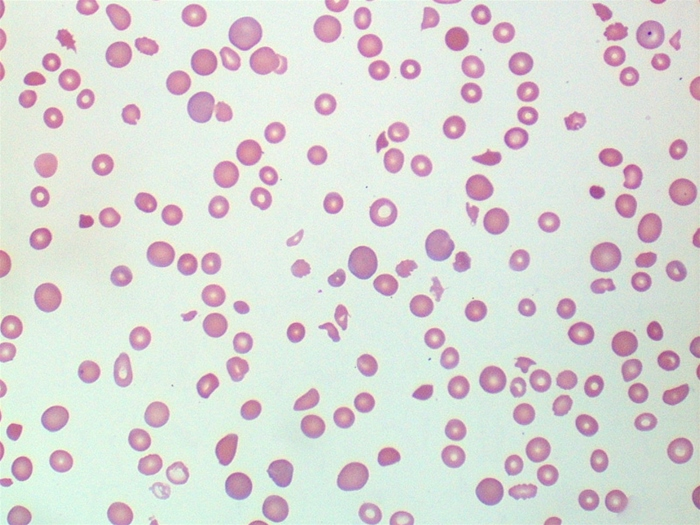
A 45-year-old woman comes to the emergency department due to worsening fatigue.  Today, she was so tired that she became short of breath doing household chores.  She has also had "spots" on her extremities and seems to bruise very easily.  The patient has had no fever, night sweats, cough, chest pain, palpitations, or abdominal pain.  She has no chronic medical problems and has had no recent cold or flu symptoms.  She does not take any medications and does not use tobacco, alcohol, or illicit drugs.  Temperature is 38 C (100.4 F) , blood pressure is 110/60 mm Hg, pulse is 92/min, and respirations are 16/min.  Physical examination shows moist mucous membranes, clear lung fields, and normal heart sounds.  The abdomen is soft and nontender with no hepatosplenomegaly.  Neurologic examination is within normal limits.  The extremities have no edema, but there are scattered petechiae and ecchymoses bilaterally.  Laboratory results are as follows: A 45-year-old woman comes to the emergency department due to worsening fatigue.  Today, she was so tired that she became short of breath doing household chores.  She has also had  spots  on her extremities and seems to bruise very easily.  The patient has had no fever, night sweats, cough, chest pain, palpitations, or abdominal pain.  She has no chronic medical problems and has had no recent cold or flu symptoms.  She does not take any medications and does not use tobacco, alcohol, or illicit drugs.  Temperature is 38 C (100.4 F) , blood pressure is 110/60 mm Hg, pulse is 92/min, and respirations are 16/min.  Physical examination shows moist mucous membranes, clear lung fields, and normal heart sounds.  The abdomen is soft and nontender with no hepatosplenomegaly.  Neurologic examination is within normal limits.  The extremities have no edema, but there are scattered petechiae and ecchymoses bilaterally.  Laboratory results are as follows:   Chest x-ray is normal.  A peripheral blood smear is shown in the exhibit.   Which of the following is the goal of the first-line therapy for this patient's current condition? A) Enhancing the release of von Willebrand factor from the endothelium B) Increasing the amount and activity of a plasma metalloprotease C) Removing the trigger for the uncontrolled activation of the coagulation cascade D) Suppressing the production of antibodies against the platelet antigens E) Transfusing platelets to decrease the risk of catastrophic bleeding Chest x-ray is normal.  A peripheral blood smear is shown in the exhibit. A 45-year-old woman comes to the emergency department due to worsening fatigue.  Today, she was so tired that she became short of breath doing household chores.  She has also had  spots  on her extremities and seems to bruise very easily.  The patient has had no fever, night sweats, cough, chest pain, palpitations, or abdominal pain.  She has no chronic medical problems and has had no recent cold or flu symptoms.  She does not take any medications and does not use tobacco, alcohol, or illicit drugs.  Temperature is 38 C (100.4 F) , blood pressure is 110/60 mm Hg, pulse is 92/min, and respirations are 16/min.  Physical examination shows moist mucous membranes, clear lung fields, and normal heart sounds.  The abdomen is soft and nontender with no hepatosplenomegaly.  Neurologic examination is within normal limits.  The extremities have no edema, but there are scattered petechiae and ecchymoses bilaterally.  Laboratory results are as follows:   Chest x-ray is normal.  A peripheral blood smear is shown in the exhibit.   Which of the following is the goal of the first-line therapy for this patient's current condition? A) Enhancing the release of von Willebrand factor from the endothelium B) Increasing the amount and activity of a plasma metalloprotease C) Removing the trigger for the uncontrolled activation of the coagulation cascade D) Suppressing the production of antibodies against the platelet antigens E) Transfusing platelets to decrease the risk of catastrophic bleeding Which of the following is the goal of the first-line therapy for this patient's current condition?

A) Enhancing the release of von Willebrand factor from the endothelium
B) Increasing the amount and activity of a plasma metalloprotease
C) Removing the trigger for the uncontrolled activation of the coagulation cascade
D) Suppressing the production of antibodies against the platelet antigens
E) Transfusing platelets to decrease the risk of catastrophic bleeding

Correct Answer:

verifed

Verified

Unlock this answer now
Get Access to more Verified Answers free of charge

Related Questions

Unlock this Answer For Free Now!

View this answer and more for free by performing one of the following actions

qr-code

Scan the QR code to install the App and get 2 free unlocks

upload documents

Unlock quizzes for free by uploading documents