A 34-year-old man is brought to the emergency department due to 3 weeks of intermittent fever, headache, malaise, and night sweats. Over the last few days, his headaches have worsened, and he has had blurry and double vision. The patient uses injection drugs and was treated for staphylococcal endocarditis 4 years ago. Temperature is 38.1 C (100.6 F) , blood pressure is 150/100 mm Hg, pulse is 66/min, and respirations are 18/min. BMI is 18.4 kg/m2. The patient is ill in appearance and somnolent but easily arousable and oriented. There are white plaques on the oropharyngeal mucosa and several skin lesions resembling molluscum contagiosum. There is increased resistance to passive neck flexion. Neurologic examination reveals leftward gaze restriction in the left eye but no other focal weakness or sensory loss. Funduscopy reveals bilateral papilledema. A noncontrast CT scan of the head shows no abnormalities. The patient receives a lumbar puncture; results of the spinal fluid analysis are as follows: 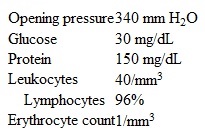 Two weeks after the treatment is started, the patient's symptoms improve and a repeat spinal fluid culture is negative. Which of the following is the best next step in management of this patient?
A) Continue current antimicrobial therapy for additional 3-4 weeks
B) Continue current antimicrobial therapy until antiretroviral therapy is started
C) Discontinue all antimicrobial therapy and advise outpatient HIV treatment
D) Discontinue the initial therapy and begin daily acyclovir
E) Discontinue the initial therapy and begin daily fluconazole
Correct Answer:

Verified
Q535: A 34-year-old man is brought to the
Q536: A 26-year-old man comes to the office
Q537: An 82-year-old woman comes to the office
Q538: A 44-year-old man comes to the office
Q539: A 40-year-old man comes to the office
Q541: A 54-year-old man comes to the office
Q542: A 28-year-old woman, gravida 2 para 1,
Q543: A 53-year-old woman comes to the office
Q544: A 19-year-old woman comes to the office
Q545: A 54-year-old man comes to the office
Unlock this Answer For Free Now!
View this answer and more for free by performing one of the following actions

Scan the QR code to install the App and get 2 free unlocks

Unlock quizzes for free by uploading documents