Solved

A 74-Year-Old Woman Is Brought to the Emergency Department with Fever

Question 653

Multiple Choice

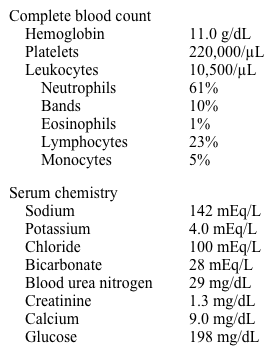
A 74-year-old woman is brought to the emergency department with fever, chills, and shortness of breath.  Two days ago, she choked while having tea and doughnuts and almost lost consciousness.  Her son performed the Heimlich maneuver.  The patient has advanced Alzheimer dementia, and her son is her health care proxy and primary caregiver; her 73-year-old husband also participates in her care.  Her other medical problems include hypertension, hyperlipidemia, coronary heart disease, ischemic stroke with mild residual right hemiparesis, history of heme-positive stools, and urine incontinence.  She is allergic to penicillin (anaphylaxis) .  Her temperature is 38.9 C (102 F) , blood pressure is 120/80 mm Hg, pulse is 92/min, and respirations are 24/min.  Pulse oxymetry shows 89% on room air and 94% on 40% facemask oxygen.  Auscultation of the chest shows crackles at the right lung base.  The heart sounds are regular.  There is no jugular venous distension.  The abdomen is soft, nontender, and nondistended.  There is no peripheral edema.  Laboratory results are as follows: A 74-year-old woman is brought to the emergency department with fever, chills, and shortness of breath.  Two days ago, she choked while having tea and doughnuts and almost lost consciousness.  Her son performed the Heimlich maneuver.  The patient has advanced Alzheimer dementia, and her son is her health care proxy and primary caregiver; her 73-year-old husband also participates in her care.  Her other medical problems include hypertension, hyperlipidemia, coronary heart disease, ischemic stroke with mild residual right hemiparesis, history of heme-positive stools, and urine incontinence.  She is allergic to penicillin (anaphylaxis) .  Her temperature is 38.9 C (102 F) , blood pressure is 120/80 mm Hg, pulse is 92/min, and respirations are 24/min.  Pulse oxymetry shows 89% on room air and 94% on 40% facemask oxygen.  Auscultation of the chest shows crackles at the right lung base.  The heart sounds are regular.  There is no jugular venous distension.  The abdomen is soft, nontender, and nondistended.  There is no peripheral edema.  Laboratory results are as follows:   A portable chest x-ray shows a right lower-lobe infiltrate. During the night, the patient deteriorates and becomes more hypoxic, requiring 100% oxygen by facemask.  Her son refuses to have her intubated.  She has several episodes of hypotension.  Aggressive intravenous fluid therapy is given, and a Foley catheter is placed.  Her blood pressure normalizes.  Over the course of the next 12 hours, her urine output drops to 5 mL/hr.  On the 4th day of hospitalization, her temperature is 37.3 C (99.1 F) , blood pressure is 122/70 mm Hg, and pulse is 78/min.  Despite receiving intravenous fluids, her urine output remains low.  Laboratory results are as follows:   Further evaluation of this patient would most likely show which of the following? A) Decreased fractional excretion of sodium B) Distension of the renal pelvis C) Eosinophils in peripheral smear and urine D) Muddy brown casts on urinalysis E) Red blood cell casts on urine sediment A portable chest x-ray shows a right lower-lobe infiltrate.
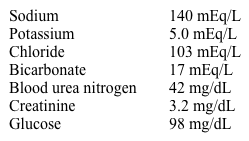
During the night, the patient deteriorates and becomes more hypoxic, requiring 100% oxygen by facemask.  Her son refuses to have her intubated.  She has several episodes of hypotension.  Aggressive intravenous fluid therapy is given, and a Foley catheter is placed.  Her blood pressure normalizes.  Over the course of the next 12 hours, her urine output drops to 5 mL/hr.  On the 4th day of hospitalization, her temperature is 37.3 C (99.1 F) , blood pressure is 122/70 mm Hg, and pulse is 78/min.  Despite receiving intravenous fluids, her urine output remains low.  Laboratory results are as follows:
A 74-year-old woman is brought to the emergency department with fever, chills, and shortness of breath.  Two days ago, she choked while having tea and doughnuts and almost lost consciousness.  Her son performed the Heimlich maneuver.  The patient has advanced Alzheimer dementia, and her son is her health care proxy and primary caregiver; her 73-year-old husband also participates in her care.  Her other medical problems include hypertension, hyperlipidemia, coronary heart disease, ischemic stroke with mild residual right hemiparesis, history of heme-positive stools, and urine incontinence.  She is allergic to penicillin (anaphylaxis) .  Her temperature is 38.9 C (102 F) , blood pressure is 120/80 mm Hg, pulse is 92/min, and respirations are 24/min.  Pulse oxymetry shows 89% on room air and 94% on 40% facemask oxygen.  Auscultation of the chest shows crackles at the right lung base.  The heart sounds are regular.  There is no jugular venous distension.  The abdomen is soft, nontender, and nondistended.  There is no peripheral edema.  Laboratory results are as follows:   A portable chest x-ray shows a right lower-lobe infiltrate. During the night, the patient deteriorates and becomes more hypoxic, requiring 100% oxygen by facemask.  Her son refuses to have her intubated.  She has several episodes of hypotension.  Aggressive intravenous fluid therapy is given, and a Foley catheter is placed.  Her blood pressure normalizes.  Over the course of the next 12 hours, her urine output drops to 5 mL/hr.  On the 4th day of hospitalization, her temperature is 37.3 C (99.1 F) , blood pressure is 122/70 mm Hg, and pulse is 78/min.  Despite receiving intravenous fluids, her urine output remains low.  Laboratory results are as follows:   Further evaluation of this patient would most likely show which of the following? A) Decreased fractional excretion of sodium B) Distension of the renal pelvis C) Eosinophils in peripheral smear and urine D) Muddy brown casts on urinalysis E) Red blood cell casts on urine sediment Further evaluation of this patient would most likely show which of the following?


A) Decreased fractional excretion of sodium
B) Distension of the renal pelvis
C) Eosinophils in peripheral smear and urine
D) Muddy brown casts on urinalysis
E) Red blood cell casts on urine sediment

Correct Answer:

verifed

Verified

Unlock this answer now
Get Access to more Verified Answers free of charge

Related Questions

Unlock this Answer For Free Now!

View this answer and more for free by performing one of the following actions

qr-code

Scan the QR code to install the App and get 2 free unlocks

upload documents

Unlock quizzes for free by uploading documents