A 74-year-old woman is brought to the emergency department with fever, chills, and shortness of breath. Two days ago, she choked while having tea and doughnuts and almost lost consciousness. Her son performed the Heimlich maneuver. The patient has advanced Alzheimer dementia, and her son is her health care proxy and primary caregiver; her 73-year-old husband also participates in her care. Her other medical problems include hypertension, hyperlipidemia, coronary heart disease, ischemic stroke with mild residual right hemiparesis, history of heme-positive stools, and urine incontinence. She is allergic to penicillin (anaphylaxis) . Her temperature is 38.9 C (102 F) , blood pressure is 120/80 mm Hg, pulse is 92/min, and respirations are 24/min. Pulse oxymetry shows 89% on room air and 94% on 40% facemask oxygen. Auscultation of the chest shows crackles at the right lung base. The heart sounds are regular. There is no jugular venous distension. The abdomen is soft, nontender, and nondistended. There is no peripheral edema. Laboratory results are as follows:  A portable chest x-ray shows a right lower-lobe infiltrate.
During the last 4 days of hospitalization, the patient has received 6 L of 0.9% saline. Her urine output has been 400 mL in the last 24 hours. She has been afebrile for the past 2 days. Her blood cultures are negative, and her urine culture grew budding yeast. The patient is currently receiving 150 mL/hr of 0.9% saline, nasogastric tube feedings, and antibiotics. Her temperature is 36.7 C (98 F) , blood pressure is 140/70 mm Hg, pulse is 82/min, respirations are 18/min, and oxygen saturation is 96% on 2 L O2 by nasal cannula. Her mucous membranes are moist. The lungs still have crackles at the right base. There is no pericardial rub, peripheral edema, or asterixis. The results of her recent basic metabolic panel are as follows: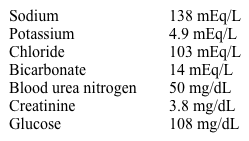 An ECG shows no abnormal intervals and no peaked T waves.
What is the most appropriate course of action at this time?
A) Arrange for urgent dialysis
B) Give a dose of intravenous furosemide
C) Start fluconazole for the candiduria
D) Stop intravenous saline
E) Switch the saline to intravenous albumin
Correct Answer:

Verified
Q643: A 48-year-old man comes to the office
Q644: A 35-year-old man comes to the office
Q645: You are the current "on call physician"
Q646: A 68-year-old man comes to the office
Q647: A 76-year-old female is seen in the
Q649: A 74-year-old woman is brought to the
Q650: A 62-year-old man is hospitalized for an
Q651: You are the current "on call physician"
Q652: You are the current "on call physician"
Q653: A 74-year-old woman is brought to the
Unlock this Answer For Free Now!
View this answer and more for free by performing one of the following actions

Scan the QR code to install the App and get 2 free unlocks

Unlock quizzes for free by uploading documents