A 79-year-old man comes to the physician with his daughter for memory loss over the last 8-12 months. She initially noticed that he had trouble with forgetfulness, followed by distractibility and difficulty with word finding and object recognition. The patient is currently dependent on her for most independent activities of daily living, including transportation and finances. He is able to dress, bathe, and toilet himself. His gait has been unstable, and he sometimes seems to get "stuck in a chair." On review of systems, he notes urinary urgency, frequency, and incontinence. He has a history of benign prostatic hyperplasia for which he takes tamsulosin. The patient has no tremor, problems with sleep, weakness, hallucinations, or sensory disturbances. On examination, his vital signs are normal. He is oriented to self only. On mental status examination, he has impairments in language, visuospatial skills, and executive function. His cranial nerves are intact. There is normal bulk and tone of the musculature. His gait is wide based and magnetic. He has decreased stride length and a slow turn requiring several steps. Laboratory results, including TSH and vitamin B12, are normal. Brain imaging is shown in the image below. 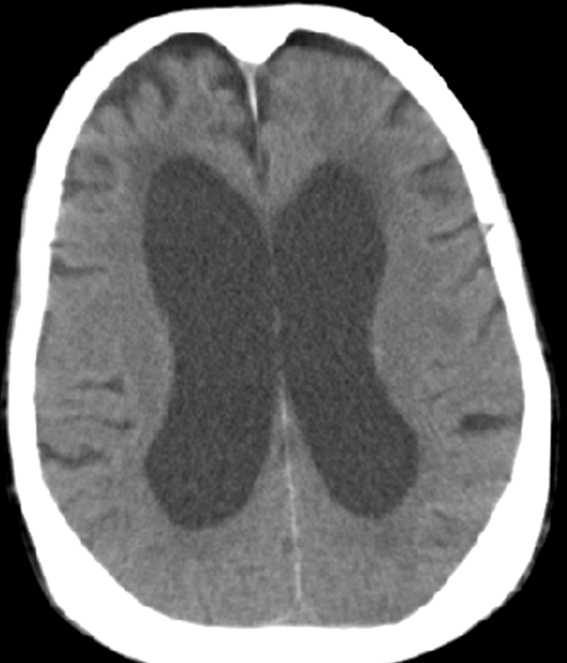 Which of the following is the most appropriate next step in management of this patient?
A) Acetazolamide
B) Carbidopa-levodopa
C) Donepezil
D) Lumbar drainage of cerebrospinal fluid
E) Ventriculoperitoneal shunting
Correct Answer:

Verified
Q720: A 65-year-old man comes to the emergency
Q721: A 9-year-old boy is brought to the
Q722: A 45-year-old Caucasian man comes to see
Q723: A 55-year-old woman comes to the emergency
Q724: A 32-year-old man comes to the office
Q726: A 54-year-old homeless man is brought to
Q727: A 24-year-old woman comes to the physician
Q728: A 14-year-old girl with a history of
Q729: An 8-year-old boy is brought to the
Q730: An 8-year-old boy with hemophilia A is
Unlock this Answer For Free Now!
View this answer and more for free by performing one of the following actions

Scan the QR code to install the App and get 2 free unlocks

Unlock quizzes for free by uploading documents