A 42-year-old man comes to the emergency department due to 4 days of nausea, skin rash, progressive weakness, and decreased urine output. For the past few months he has also had fatigue, tingling in his hands and feet, and occasional joint pains. The patient has had no fever, chest pain, dysuria, hematuria, or diarrhea. He has no chronic medical problems and takes no medication. The patient does not use tobacco or alcohol but used injection drugs during his early 20s. Temperature is 37.6 C (99.8 F) , blood pressure is 150/90 mm Hg, pulse is 92/min, and respirations are 16/min. BMI is 24.8 kg/m2. Mucous membranes are dry with no lesions. Cardiopulmonary auscultation is normal. The liver edge is palpable 2 cm below the right costal margin. Bilateral ankle reflexes are absent. He has mild, bilateral, lower-extremity pitting edema and a palpable, nonblanchable, purpuric rash on both legs. There is no joint swelling or erythema. Laboratory results are as follows: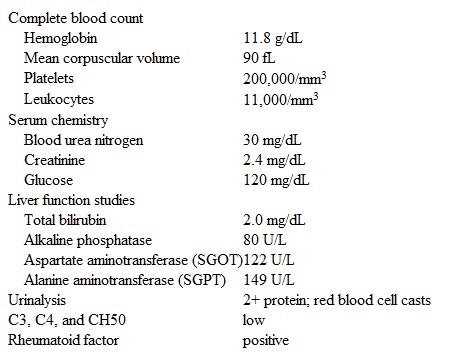 The diagnosis is established and the patient's renal function stabilizes with initial therapy. Which of the following is most appropriate for the long-term management of this patient?
A) Antibiotic prophylaxis
B) Antiviral treatment
C) Close observation with supportive care
D) Extended immunosuppressive therapy
E) Liver-kidney transplantation
Correct Answer:

Verified
Q973: A 17-year-old male presents to the office
Q974: A 54-year-old woman comes to the physician
Q975: What is the most appropriate means of
Q976: A 76-year-old woman is hospitalized due to
Q977: A 55-year-old man comes to the office
Q979: A 62-year-old woman comes to the office
Q980: A 77-year-old man is brought to the
Q981: A 17-year-old boy is evaluated for abnormal
Q982: A 76-year-old man comes to the office
Q983: A 12-year-old boy is brought to the
Unlock this Answer For Free Now!
View this answer and more for free by performing one of the following actions

Scan the QR code to install the App and get 2 free unlocks

Unlock quizzes for free by uploading documents