A 77-year-old man is brought to the physician by his daughter with a 1-week history of gross hematuria. He has no frequency, urgency, hesitancy, or dribbling. His other medical problems include hypertension, chronic low back pain, and chronic renal insufficiency. The patient's medications include amlodipine, hydrochlorothiazide, and acetaminophen with codeine as needed. He has a 46-pack-year smoking history. Prostate examination shows no abnormalities. Laboratory results are as follows: 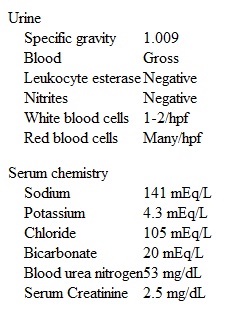 Urine microscopy shows many normal-appearing red cells, but no dysmorphic red cells or casts. Urine culture shows no growth. Prostate-specific antigen is 3.2 ng/mL. Ultrasound of the kidneys shows bilateral cortical atrophy but no other lesions. Which of the following is the most appropriate next step in management of this patient?
A) Abdominal computed tomography scan
B) Cystoscopy
C) Intravenous pyelography
D) Renal biopsy
E) Urine cytology
Correct Answer:

Verified
Q975: What is the most appropriate means of
Q976: A 76-year-old woman is hospitalized due to
Q977: A 55-year-old man comes to the office
Q978: A 42-year-old man comes to the emergency
Q979: A 62-year-old woman comes to the office
Q981: A 17-year-old boy is evaluated for abnormal
Q982: A 76-year-old man comes to the office
Q983: A 12-year-old boy is brought to the
Q984: A 40-year-old man is evaluated for perioral
Q985: A 15-year-old boy with chronic kidney disease
Unlock this Answer For Free Now!
View this answer and more for free by performing one of the following actions

Scan the QR code to install the App and get 2 free unlocks

Unlock quizzes for free by uploading documents