A 40-year-old man is evaluated for perioral paresthesias and cramping of both hands. The patient has a history of alcoholic cirrhosis and was admitted 24 hours ago due to recurrent episodes of hematemesis. Evaluation revealed acute variceal bleeding for which the patient received endoscopic therapy. He also received 6 units of packed red blood cells and 4 units of fresh frozen plasma since admission. The patient reports feelings of anxiety and worsening tingling and numbness around the mouth for the past 2 hours. He has also had severe muscle spasms of the hands and legs. Temperature is 37.1 C (98.8 F) , blood pressure is 116/68 mm Hg, and pulse is 92/min. Jugular venous pressure is normal. The lungs are clear to auscultation and heart sounds are normal. Abdominal examination reveals moderate ascites with no tenderness. He has generalized mild muscle weakness and periodic spontaneous twitching in the major muscle groups. Laboratory studies at the time of admission are as follows: 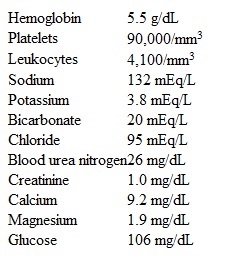 Hemoglobin level after the transfusions is 8.9 g/dL. Further diagnostic testing is pending. Intravenous administration of which of the following is most likely to improve this patient's current symptoms?
A) Calcium gluconate
B) Dextrose and thiamine
C) Lorazepam
D) Potassium chloride
E) Sodium bicarbonate
Correct Answer:

Verified
Q979: A 62-year-old woman comes to the office
Q980: A 77-year-old man is brought to the
Q981: A 17-year-old boy is evaluated for abnormal
Q982: A 76-year-old man comes to the office
Q983: A 12-year-old boy is brought to the
Q985: A 15-year-old boy with chronic kidney disease
Q986: A 40-year-old man comes to the nephrology
Q987: A 17-year-old boy is evaluated for abnormal
Q988: An elderly male is brought to the
Q989: A 42-year-old woman comes to the office
Unlock this Answer For Free Now!
View this answer and more for free by performing one of the following actions

Scan the QR code to install the App and get 2 free unlocks

Unlock quizzes for free by uploading documents