A 29-year-old woman comes to the office due to 3 months of worsening exertional dyspnea and nonproductive cough. The patient says, "I thought the symptoms were from a cold or allergies, but they have not gone away and have gotten worse. None of the over-the-counter congestion medicines from the pharmacy have helped." She has also had occasional joint pain and has felt too tired to keep up with her exercise routine of running 5 miles 3 times a week. She has had no chest pain, palpitations, syncope, or leg edema. The patient has no chronic medical problems and does not use tobacco, alcohol, or illicit drugs. Her brother has asthma. Laboratory results are as follows:  Chest radiography is shown in the exhibit.
 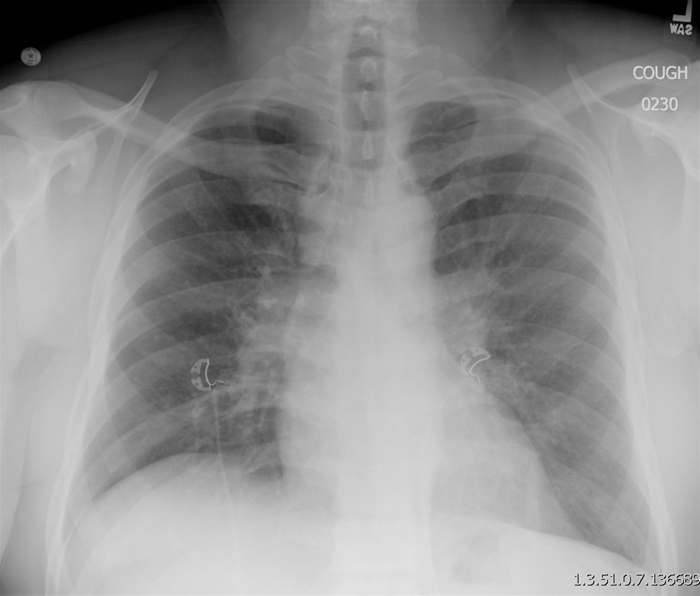 Pulmonary function testing reveals that FEV1 is 60% of the predicted value, FEV1/FVC is 80%, and diffusion capacity for carbon monoxide is 60% of predicted. After discussion of a likely diagnosis and possible therapy, the patient asks about long-term prognosis. Which of the following is the most appropriate response to this patient?
A) Avoidance of triggering agents should help you prevent future recurrences.
B) Most people with your condition develop progressive lung scarring.
C) There is a high possibility that your condition will resolve over time.
D) You are at increased risk for disease complications due to early age of onset.
E) You need lifelong immunosuppressive therapy to prevent lung damage.
Correct Answer:

Verified
Q1065: A 45-year-old woman comes to the office
Q1066: A 33-year-old Caucasian female presents to your
Q1067: A 2-year-old girl is brought to the
Q1068: A 33-year-old Caucasian female presents to your
Q1069: A 45-year-old woman comes to the office
Q1071: A 12-year-old girl is brought to the
Q1072: A 48-year-old man comes to the office
Q1073: A 27-year-old man comes to the physician
Q1074: A 12-year-old girl is brought to the
Q1075: A 25-year-old man comes to the emergency
Unlock this Answer For Free Now!
View this answer and more for free by performing one of the following actions

Scan the QR code to install the App and get 2 free unlocks

Unlock quizzes for free by uploading documents