Solved

Passage the Drug Paracetamol, Also Known as Acetaminophen, Is Used to to Relieve

Question 7

Multiple Choice

Passage
The drug paracetamol, also known as acetaminophen, is used to relieve pain and fever, and is a metabolite of the antipyretic drug phenacetin (Figure 1) .  These two drugs have similar medicinal properties, but phenacetin has been shown to be carcinogenic and cause kidney damage.  Acetaminophen is a safer alternative to phenacetin when taken in therapeutic doses.
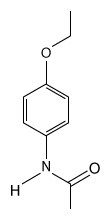
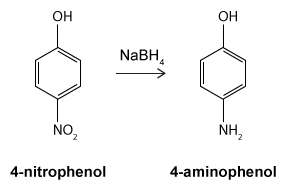
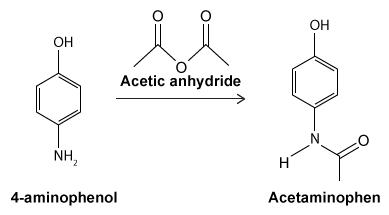
Passage The drug paracetamol, also known as acetaminophen, is used to relieve pain and fever, and is a metabolite of the antipyretic drug phenacetin (Figure 1) .  These two drugs have similar medicinal properties, but phenacetin has been shown to be carcinogenic and cause kidney damage.  Acetaminophen is a safer alternative to phenacetin when taken in therapeutic doses.    <strong>Figure 1</strong>  Structure of phenacetinA student synthesizes acetaminophen in a laboratory from phenol according to the reactions shown.  The synthesis begins with the nitration of phenol by sodium nitrate (NaNO<sub>3</sub>)  to produce the mixture of the isomers 2-nitrophenol and 4-nitrophenol (Reaction 1) .  These isomers can be easily separated by steam distillation to isolate the desired product, 4-nitrophenol.  Reduction of the nitro group with sodium borohydride (NaBH<sub>4</sub>)  (Reaction 2)  is followed by acetylation of the amine with acetic anhydride (Reaction 3)  to afford the final product, acetaminophen.    <strong>Reaction 1</strong>    <strong>Reaction 2</strong>    <strong>Reaction 3</strong> -  Normal phase thin layer chromatography (TLC)  was used to monitor the formation of acetaminophen.  According to the TLC plate shown, which spot has an R<sub>f</sub> value of 0.33, and what compound most likely corresponds to this spot? A) Spot A; acetaminophen B) Spot B; acetaminophen C) Spot A; 4-aminophenol D) Spot B; 4-aminophenol Figure 1  Structure of phenacetinA student synthesizes acetaminophen in a laboratory from phenol according to the reactions shown.  The synthesis begins with the nitration of phenol by sodium nitrate (NaNO3) to produce the mixture of the isomers 2-nitrophenol and 4-nitrophenol (Reaction 1) .  These isomers can be easily separated by steam distillation to isolate the desired product, 4-nitrophenol.  Reduction of the nitro group with sodium borohydride (NaBH4) (Reaction 2) is followed by acetylation of the amine with acetic anhydride (Reaction 3) to afford the final product, acetaminophen.
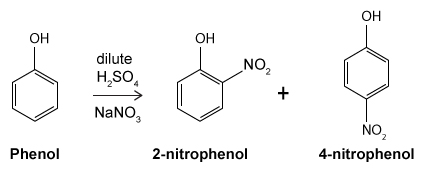
Passage The drug paracetamol, also known as acetaminophen, is used to relieve pain and fever, and is a metabolite of the antipyretic drug phenacetin (Figure 1) .  These two drugs have similar medicinal properties, but phenacetin has been shown to be carcinogenic and cause kidney damage.  Acetaminophen is a safer alternative to phenacetin when taken in therapeutic doses.    <strong>Figure 1</strong>  Structure of phenacetinA student synthesizes acetaminophen in a laboratory from phenol according to the reactions shown.  The synthesis begins with the nitration of phenol by sodium nitrate (NaNO<sub>3</sub>)  to produce the mixture of the isomers 2-nitrophenol and 4-nitrophenol (Reaction 1) .  These isomers can be easily separated by steam distillation to isolate the desired product, 4-nitrophenol.  Reduction of the nitro group with sodium borohydride (NaBH<sub>4</sub>)  (Reaction 2)  is followed by acetylation of the amine with acetic anhydride (Reaction 3)  to afford the final product, acetaminophen.    <strong>Reaction 1</strong>    <strong>Reaction 2</strong>    <strong>Reaction 3</strong> -  Normal phase thin layer chromatography (TLC)  was used to monitor the formation of acetaminophen.  According to the TLC plate shown, which spot has an R<sub>f</sub> value of 0.33, and what compound most likely corresponds to this spot? A) Spot A; acetaminophen B) Spot B; acetaminophen C) Spot A; 4-aminophenol D) Spot B; 4-aminophenol Reaction 1
Passage The drug paracetamol, also known as acetaminophen, is used to relieve pain and fever, and is a metabolite of the antipyretic drug phenacetin (Figure 1) .  These two drugs have similar medicinal properties, but phenacetin has been shown to be carcinogenic and cause kidney damage.  Acetaminophen is a safer alternative to phenacetin when taken in therapeutic doses.    <strong>Figure 1</strong>  Structure of phenacetinA student synthesizes acetaminophen in a laboratory from phenol according to the reactions shown.  The synthesis begins with the nitration of phenol by sodium nitrate (NaNO<sub>3</sub>)  to produce the mixture of the isomers 2-nitrophenol and 4-nitrophenol (Reaction 1) .  These isomers can be easily separated by steam distillation to isolate the desired product, 4-nitrophenol.  Reduction of the nitro group with sodium borohydride (NaBH<sub>4</sub>)  (Reaction 2)  is followed by acetylation of the amine with acetic anhydride (Reaction 3)  to afford the final product, acetaminophen.    <strong>Reaction 1</strong>    <strong>Reaction 2</strong>    <strong>Reaction 3</strong> -  Normal phase thin layer chromatography (TLC)  was used to monitor the formation of acetaminophen.  According to the TLC plate shown, which spot has an R<sub>f</sub> value of 0.33, and what compound most likely corresponds to this spot? A) Spot A; acetaminophen B) Spot B; acetaminophen C) Spot A; 4-aminophenol D) Spot B; 4-aminophenol Reaction 2
Passage The drug paracetamol, also known as acetaminophen, is used to relieve pain and fever, and is a metabolite of the antipyretic drug phenacetin (Figure 1) .  These two drugs have similar medicinal properties, but phenacetin has been shown to be carcinogenic and cause kidney damage.  Acetaminophen is a safer alternative to phenacetin when taken in therapeutic doses.    <strong>Figure 1</strong>  Structure of phenacetinA student synthesizes acetaminophen in a laboratory from phenol according to the reactions shown.  The synthesis begins with the nitration of phenol by sodium nitrate (NaNO<sub>3</sub>)  to produce the mixture of the isomers 2-nitrophenol and 4-nitrophenol (Reaction 1) .  These isomers can be easily separated by steam distillation to isolate the desired product, 4-nitrophenol.  Reduction of the nitro group with sodium borohydride (NaBH<sub>4</sub>)  (Reaction 2)  is followed by acetylation of the amine with acetic anhydride (Reaction 3)  to afford the final product, acetaminophen.    <strong>Reaction 1</strong>    <strong>Reaction 2</strong>    <strong>Reaction 3</strong> -  Normal phase thin layer chromatography (TLC)  was used to monitor the formation of acetaminophen.  According to the TLC plate shown, which spot has an R<sub>f</sub> value of 0.33, and what compound most likely corresponds to this spot? A) Spot A; acetaminophen B) Spot B; acetaminophen C) Spot A; 4-aminophenol D) Spot B; 4-aminophenol Reaction 3
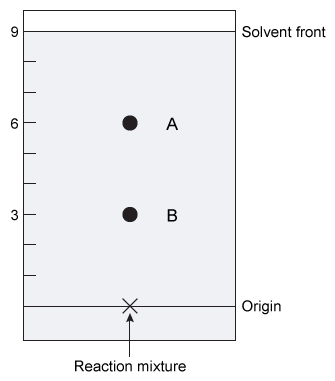
-Passage The drug paracetamol, also known as acetaminophen, is used to relieve pain and fever, and is a metabolite of the antipyretic drug phenacetin (Figure 1) .  These two drugs have similar medicinal properties, but phenacetin has been shown to be carcinogenic and cause kidney damage.  Acetaminophen is a safer alternative to phenacetin when taken in therapeutic doses.    <strong>Figure 1</strong>  Structure of phenacetinA student synthesizes acetaminophen in a laboratory from phenol according to the reactions shown.  The synthesis begins with the nitration of phenol by sodium nitrate (NaNO<sub>3</sub>)  to produce the mixture of the isomers 2-nitrophenol and 4-nitrophenol (Reaction 1) .  These isomers can be easily separated by steam distillation to isolate the desired product, 4-nitrophenol.  Reduction of the nitro group with sodium borohydride (NaBH<sub>4</sub>)  (Reaction 2)  is followed by acetylation of the amine with acetic anhydride (Reaction 3)  to afford the final product, acetaminophen.    <strong>Reaction 1</strong>    <strong>Reaction 2</strong>    <strong>Reaction 3</strong> -  Normal phase thin layer chromatography (TLC)  was used to monitor the formation of acetaminophen.  According to the TLC plate shown, which spot has an R<sub>f</sub> value of 0.33, and what compound most likely corresponds to this spot? A) Spot A; acetaminophen B) Spot B; acetaminophen C) Spot A; 4-aminophenol D) Spot B; 4-aminophenol Normal phase thin layer chromatography (TLC) was used to monitor the formation of acetaminophen.  According to the TLC plate shown, which spot has an Rf value of 0.33, and what compound most likely corresponds to this spot?


A) Spot A; acetaminophen
B) Spot B; acetaminophen
C) Spot A; 4-aminophenol
D) Spot B; 4-aminophenol

Correct Answer:

verifed

Verified

Unlock this answer now
Get Access to more Verified Answers free of charge

Related Questions

Unlock this Answer For Free Now!

View this answer and more for free by performing one of the following actions

qr-code

Scan the QR code to install the App and get 2 free unlocks

upload documents

Unlock quizzes for free by uploading documents