Passage
Fatty acids (FAs) are lipids that play important roles in cellular function, including energy storage and membrane structure. Most polyunsaturated fatty acids (PUFAs) are made in the body; however, omega-3 alpha-linolenic acid and omega-6 linoleic acid must be obtained from the diet. These two PUFAs are precursors to other omega-3 and omega-6 long-chain FAs that are necessary for physiological processes such as neurological development, normal growth, and immune response. Insufficient omega-3 and omega-6 long-chain FAs can lead to an increase in omega-9 fatty acids such as mead acid, and to essential fatty acid deficiency (EFAD) , which can cause infertility, decreased growth, and increased susceptibility to infection.Total FA levels in plasma and serum can be used to diagnose EFAD. Plasma and serum samples from several individuals were hydrolyzed to release FAs from triacylglycerols and phospholipids. Once isolated, the free FAs were converted to pentafluorobenzyl (PFB) derivatives and separated by gas chromatography (GC) . Total levels of each type of fatty acid were quantified by negative chemical ionization-mass spectrometry (NCI-MS) immediately after GC. NCI is an ionization technique that creates negatively charged ions with little to no fragmentation. The NCI-MS revealed that two of the peaks from GC had the same m/z ratio (Figure 1) . They were both confirmed to be forms of an unsaturated, unbranched 22-carbon FA called omega-9 docosenoic acid.
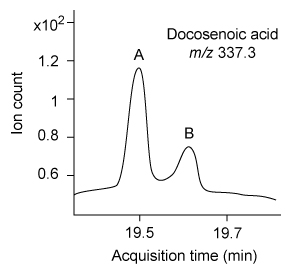 Figure 1 Selected ion chromatogram of docosenoic acidResearchers have proposed that an elevated ratio of the triene omega-9 mead acid to the tetraene omega-6 arachidonic acid, known as the triene/tetraene (TT) ratio, can signify EFAD. Using GC and NCI-MS, they measured the TT ratio, concentration of mead acid, and individual concentrations of omega-3 and omega-6 FAs in plasma and serum samples from three patients and compared their results to normal ranges. An increased TT ratio and mead acid concentration and decreased omega-3 and omega-6 FA concentrations were observed in the patient samples compared to normal ranges.
Adapted from E. Kish-Trier et al., "Quantitation of total fatty acids in plasma and serum by GC-NCI-MS." Clinical Mass Spectrometry. ©2016 Elsevier.
-A triacylglyceride isolated from a plasma sample is shown below. 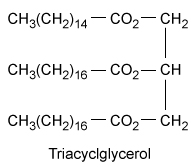 When the triacylglyceride is hydrolyzed, how many unique products are obtained other than glycerol?
A) 0
B) 1
C) 2
D) 3
Correct Answer:

Verified
Q121: Passage
Fatty acids (FAs) are lipids that play
Q122: Passage
Solid-phase peptide synthesis is normally carried out
Q123: Passage
Solid-phase peptide synthesis is normally carried out
Q124: The experimental data obtained when a chiral
Q125: Passage
Solid-phase peptide synthesis is normally carried out
Q127: Passage
Fatty acids (FAs) are lipids that play
Q128: Passage
Chloramphenicol (Compound 1) is an antibiotic that
Q129: Passage
Chloramphenicol (Compound 1) is an antibiotic that
Q130: Passage
Malaria is caused by the parasite Plasmodium
Q131: Passage
Chloramphenicol (Compound 1) is an antibiotic that
Unlock this Answer For Free Now!
View this answer and more for free by performing one of the following actions

Scan the QR code to install the App and get 2 free unlocks

Unlock quizzes for free by uploading documents