Solved

Passage Chloramphenicol (Compound 1) Is an Antibiotic That Acts Against Gram-Positive

Question 140

Multiple Choice

Passage
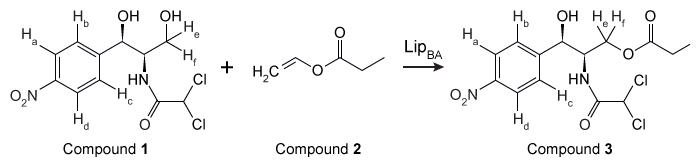
Chloramphenicol (Compound 1) is an antibiotic that acts against gram-positive and gram-negative bacteria by blocking peptidyl transfer, which inhibits protein synthesis by bacterial ribosomes.  However, it tastes bitter, so most patients cannot tolerate it.  As a result, synthesis of hydroxyl-substituted chloramphenicol analogues has become of interest because ester chloramphenicol analogues taste better than chloramphenicol.  Substituents on the primary hydroxyl group of chloramphenicol analogues are typically hydrolyzed quickly in vivo to regenerate Compound 1.  Compound 3, a chloramphenicol analogue, was synthesized by the transesterification of Compound 1 and vinyl propionate (Compound 2) , catalyzed by the enzyme LipBA lipase (Figure 1) .
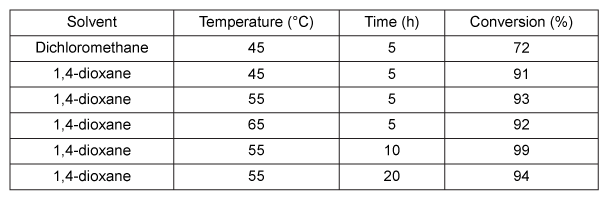
Passage Chloramphenicol (Compound <strong>1</strong>)  is an antibiotic that acts against gram-positive and gram-negative bacteria by blocking peptidyl transfer, which inhibits protein synthesis by bacterial ribosomes.  However, it tastes bitter, so most patients cannot tolerate it.  As a result, synthesis of hydroxyl-substituted chloramphenicol analogues has become of interest because ester chloramphenicol analogues taste better than chloramphenicol.  Substituents on the primary hydroxyl group of chloramphenicol analogues are typically hydrolyzed quickly in vivo to regenerate Compound <strong>1</strong>.  Compound <strong>3</strong>, a chloramphenicol analogue, was synthesized by the transesterification of Compound <strong>1</strong> and vinyl propionate (Compound <strong>2</strong>) , catalyzed by the enzyme Lip<sub>BA</sub> lipase (Figure 1) .    <strong>Figure 1</strong>  Transesterification of chloramphenicol catalyzed by Lip<sub>BA</sub>Although enzyme catalysis allows for efficient regiospecific and stereospecific bond formation, the reaction conditions for the conversion efficiency of Compound <strong>1</strong> to Compound <strong>3</strong>, as well as the purity of Compound <strong>3</strong>, must also be optimized.  The reaction solvent, temperature, and time were studied to find the conditions that gave the highest conversion rate and purity.  Each parameter was altered individually while all others were kept constant, and the enzyme concentration was 4.5 g/L in each trial.  The results of this study are shown in Table 1.  The purity of Compound <strong>3</strong> was found to be over 90% when 1,4-dioxane was used and over 70% when dichloromethane was used.<strong>Table 1</strong>  Transesterification Conditions Optimization    The transesterification reaction was monitored by thin-layer chromatography (Figure 2) , and the product was confirmed by <sup>1</sup>H NMR.  The <sup>1</sup>H NMR spectra of Compounds <strong>1</strong> and <strong>3</strong> can be distinguished by the shift of H<sub>e</sub> and H<sub>f</sub> due to the addition of the electronegative ester functional group.    <strong>Figure 2</strong>  Thin-layer chromatography of reaction mixture Adapted from F. Dong et al.,  Transesterification Synthesis of Chloramphenicol.  Molecules. ©2017 MDPI. -What is the number of signals corresponding to aromatic hydrogen atoms present in the <sup>1</sup>H NMR spectrum of Compound <strong>3</strong>? A) 1 B) 2 C) 3 D) 4 Figure 1  Transesterification of chloramphenicol catalyzed by LipBAAlthough enzyme catalysis allows for efficient regiospecific and stereospecific bond formation, the reaction conditions for the conversion efficiency of Compound 1 to Compound 3, as well as the purity of Compound 3, must also be optimized.  The reaction solvent, temperature, and time were studied to find the conditions that gave the highest conversion rate and purity.  Each parameter was altered individually while all others were kept constant, and the enzyme concentration was 4.5 g/L in each trial.  The results of this study are shown in Table 1.  The purity of Compound 3 was found to be over 90% when 1,4-dioxane was used and over 70% when dichloromethane was used.Table 1  Transesterification Conditions Optimization
Passage Chloramphenicol (Compound <strong>1</strong>)  is an antibiotic that acts against gram-positive and gram-negative bacteria by blocking peptidyl transfer, which inhibits protein synthesis by bacterial ribosomes.  However, it tastes bitter, so most patients cannot tolerate it.  As a result, synthesis of hydroxyl-substituted chloramphenicol analogues has become of interest because ester chloramphenicol analogues taste better than chloramphenicol.  Substituents on the primary hydroxyl group of chloramphenicol analogues are typically hydrolyzed quickly in vivo to regenerate Compound <strong>1</strong>.  Compound <strong>3</strong>, a chloramphenicol analogue, was synthesized by the transesterification of Compound <strong>1</strong> and vinyl propionate (Compound <strong>2</strong>) , catalyzed by the enzyme Lip<sub>BA</sub> lipase (Figure 1) .    <strong>Figure 1</strong>  Transesterification of chloramphenicol catalyzed by Lip<sub>BA</sub>Although enzyme catalysis allows for efficient regiospecific and stereospecific bond formation, the reaction conditions for the conversion efficiency of Compound <strong>1</strong> to Compound <strong>3</strong>, as well as the purity of Compound <strong>3</strong>, must also be optimized.  The reaction solvent, temperature, and time were studied to find the conditions that gave the highest conversion rate and purity.  Each parameter was altered individually while all others were kept constant, and the enzyme concentration was 4.5 g/L in each trial.  The results of this study are shown in Table 1.  The purity of Compound <strong>3</strong> was found to be over 90% when 1,4-dioxane was used and over 70% when dichloromethane was used.<strong>Table 1</strong>  Transesterification Conditions Optimization    The transesterification reaction was monitored by thin-layer chromatography (Figure 2) , and the product was confirmed by <sup>1</sup>H NMR.  The <sup>1</sup>H NMR spectra of Compounds <strong>1</strong> and <strong>3</strong> can be distinguished by the shift of H<sub>e</sub> and H<sub>f</sub> due to the addition of the electronegative ester functional group.    <strong>Figure 2</strong>  Thin-layer chromatography of reaction mixture Adapted from F. Dong et al.,  Transesterification Synthesis of Chloramphenicol.  Molecules. ©2017 MDPI. -What is the number of signals corresponding to aromatic hydrogen atoms present in the <sup>1</sup>H NMR spectrum of Compound <strong>3</strong>? A) 1 B) 2 C) 3 D) 4 The transesterification reaction was monitored by thin-layer chromatography (Figure 2) , and the product was confirmed by 1H NMR.  The 1H NMR spectra of Compounds 1 and 3 can be distinguished by the shift of He and Hf due to the addition of the electronegative ester functional group.
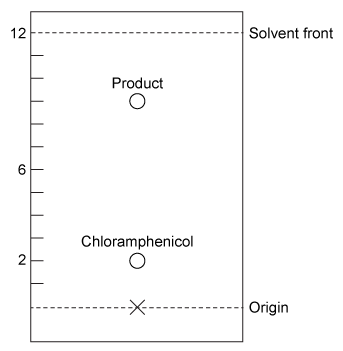
Passage Chloramphenicol (Compound <strong>1</strong>)  is an antibiotic that acts against gram-positive and gram-negative bacteria by blocking peptidyl transfer, which inhibits protein synthesis by bacterial ribosomes.  However, it tastes bitter, so most patients cannot tolerate it.  As a result, synthesis of hydroxyl-substituted chloramphenicol analogues has become of interest because ester chloramphenicol analogues taste better than chloramphenicol.  Substituents on the primary hydroxyl group of chloramphenicol analogues are typically hydrolyzed quickly in vivo to regenerate Compound <strong>1</strong>.  Compound <strong>3</strong>, a chloramphenicol analogue, was synthesized by the transesterification of Compound <strong>1</strong> and vinyl propionate (Compound <strong>2</strong>) , catalyzed by the enzyme Lip<sub>BA</sub> lipase (Figure 1) .    <strong>Figure 1</strong>  Transesterification of chloramphenicol catalyzed by Lip<sub>BA</sub>Although enzyme catalysis allows for efficient regiospecific and stereospecific bond formation, the reaction conditions for the conversion efficiency of Compound <strong>1</strong> to Compound <strong>3</strong>, as well as the purity of Compound <strong>3</strong>, must also be optimized.  The reaction solvent, temperature, and time were studied to find the conditions that gave the highest conversion rate and purity.  Each parameter was altered individually while all others were kept constant, and the enzyme concentration was 4.5 g/L in each trial.  The results of this study are shown in Table 1.  The purity of Compound <strong>3</strong> was found to be over 90% when 1,4-dioxane was used and over 70% when dichloromethane was used.<strong>Table 1</strong>  Transesterification Conditions Optimization    The transesterification reaction was monitored by thin-layer chromatography (Figure 2) , and the product was confirmed by <sup>1</sup>H NMR.  The <sup>1</sup>H NMR spectra of Compounds <strong>1</strong> and <strong>3</strong> can be distinguished by the shift of H<sub>e</sub> and H<sub>f</sub> due to the addition of the electronegative ester functional group.    <strong>Figure 2</strong>  Thin-layer chromatography of reaction mixture Adapted from F. Dong et al.,  Transesterification Synthesis of Chloramphenicol.  Molecules. ©2017 MDPI. -What is the number of signals corresponding to aromatic hydrogen atoms present in the <sup>1</sup>H NMR spectrum of Compound <strong>3</strong>? A) 1 B) 2 C) 3 D) 4 Figure 2  Thin-layer chromatography of reaction mixture
Adapted from F. Dong et al., "Transesterification Synthesis of Chloramphenicol." Molecules. ©2017 MDPI.
-What is the number of signals corresponding to aromatic hydrogen atoms present in the 1H NMR spectrum of Compound 3?


A) 1
B) 2
C) 3
D) 4

Correct Answer:

verifed

Verified

Unlock this answer now
Get Access to more Verified Answers free of charge

Related Questions

Unlock this Answer For Free Now!

View this answer and more for free by performing one of the following actions

qr-code

Scan the QR code to install the App and get 2 free unlocks

upload documents

Unlock quizzes for free by uploading documents