Solved

An 83-Year-Old Woman Is Brought to the Emergency Department Due

Question 20

Multiple Choice

An 83-year-old woman is brought to the emergency department due to chest pressure accompanied by nausea and vomiting.  She felt well until 3 days ago when she was watching television and experienced substernal chest discomfort that radiated to her back.  The pain lasted nearly an hour before resolving spontaneously; she also had nausea and vomiting at that time.  The patient has never had chest pain before and has had no further discomfort since.  She attributes the entire experience to drinking expired milk.  The patient is currently without symptoms but is seen in the emergency department at the insistence of her daughter, who is a physician.  Other medical problems include overactive bladder and osteoarthritis.  Medications include oxybutynin and ibuprofen as needed.
Blood pressure is 110/75 mm Hg, pulse is 61/min, and respirations are 12/min.  The patient is in no acute distress.  Jugular venous pulsations are normal.  Lungs are clear to auscultation bilaterally.  Apical impulse is normal.  No heart murmurs are heard.  Pulses are 2+ and symmetrical.  There is no edema.
ECG shows normal sinus rhythm with 2-mm Q waves in leads II, III, and aVF.  Laboratory results are as follows:
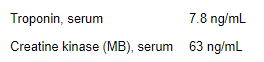
An 83-year-old woman is brought to the emergency department due to chest pressure accompanied by nausea and vomiting.  She felt well until 3 days ago when she was watching television and experienced substernal chest discomfort that radiated to her back.  The pain lasted nearly an hour before resolving spontaneously; she also had nausea and vomiting at that time.  The patient has never had chest pain before and has had no further discomfort since.  She attributes the entire experience to drinking expired milk.  The patient is currently without symptoms but is seen in the emergency department at the insistence of her daughter, who is a physician.  Other medical problems include overactive bladder and osteoarthritis.  Medications include oxybutynin and ibuprofen as needed. Blood pressure is 110/75 mm Hg, pulse is 61/min, and respirations are 12/min.  The patient is in no acute distress.  Jugular venous pulsations are normal.  Lungs are clear to auscultation bilaterally.  Apical impulse is normal.  No heart murmurs are heard.  Pulses are 2+ and symmetrical.  There is no edema. ECG shows normal sinus rhythm with 2-mm Q waves in leads II, III, and aVF.  Laboratory results are as follows:   The patient is admitted to the intensive care unit and scheduled for coronary angiography.  Shortly after arriving on the floor, she is noted to be markedly dyspneic.  Repeat blood pressure is 90/45 mm Hg, pulse is 125/min, and respirations are 20/min.  Lung examination reveals bilateral diffuse crackles.  A pulmonary arterial catheter is placed, with the results shown below.   Which of the following is the most likely diagnosis in this patient? A) Left ventricular aneurysm B) Papillary muscle rupture C) Pulmonary embolism D) Right ventricular infarction E) Ruptured ventricular septum The patient is admitted to the intensive care unit and scheduled for coronary angiography.  Shortly after arriving on the floor, she is noted to be markedly dyspneic.  Repeat blood pressure is 90/45 mm Hg, pulse is 125/min, and respirations are 20/min.  Lung examination reveals bilateral diffuse crackles.  A pulmonary arterial catheter is placed, with the results shown below.
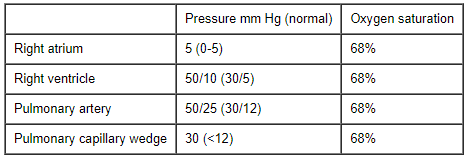
An 83-year-old woman is brought to the emergency department due to chest pressure accompanied by nausea and vomiting.  She felt well until 3 days ago when she was watching television and experienced substernal chest discomfort that radiated to her back.  The pain lasted nearly an hour before resolving spontaneously; she also had nausea and vomiting at that time.  The patient has never had chest pain before and has had no further discomfort since.  She attributes the entire experience to drinking expired milk.  The patient is currently without symptoms but is seen in the emergency department at the insistence of her daughter, who is a physician.  Other medical problems include overactive bladder and osteoarthritis.  Medications include oxybutynin and ibuprofen as needed. Blood pressure is 110/75 mm Hg, pulse is 61/min, and respirations are 12/min.  The patient is in no acute distress.  Jugular venous pulsations are normal.  Lungs are clear to auscultation bilaterally.  Apical impulse is normal.  No heart murmurs are heard.  Pulses are 2+ and symmetrical.  There is no edema. ECG shows normal sinus rhythm with 2-mm Q waves in leads II, III, and aVF.  Laboratory results are as follows:   The patient is admitted to the intensive care unit and scheduled for coronary angiography.  Shortly after arriving on the floor, she is noted to be markedly dyspneic.  Repeat blood pressure is 90/45 mm Hg, pulse is 125/min, and respirations are 20/min.  Lung examination reveals bilateral diffuse crackles.  A pulmonary arterial catheter is placed, with the results shown below.   Which of the following is the most likely diagnosis in this patient? A) Left ventricular aneurysm B) Papillary muscle rupture C) Pulmonary embolism D) Right ventricular infarction E) Ruptured ventricular septum Which of the following is the most likely diagnosis in this patient?


A) Left ventricular aneurysm
B) Papillary muscle rupture
C) Pulmonary embolism
D) Right ventricular infarction
E) Ruptured ventricular septum

Correct Answer:

verifed

Verified

Unlock this answer now
Get Access to more Verified Answers free of charge

Related Questions

Unlock this Answer For Free Now!

View this answer and more for free by performing one of the following actions

qr-code

Scan the QR code to install the App and get 2 free unlocks

upload documents

Unlock quizzes for free by uploading documents