Solved

An 85-Year-Old Nursing Home Resident Is Brought to the Emergency

Question 181

Multiple Choice

An 85-year-old nursing home resident is brought to the emergency department due to worsening cough, difficulty breathing, and decreased responsiveness for 3 days.  Medical conditions include hypertension, type 2 diabetes mellitus, and dementia.  Following evaluation that reveals leukocytosis and lung infiltrates, the patient's respiratory distress progressively worsens.  Endotracheal intubation is performed; mechanical ventilation is begun; the patient is given intravenous fluids and antibiotics; a central venous catheter is placed; and she is admitted to the intensive care unit (ICU) .
In the ICU, the patient requires increasing ventilatory support with elevated airway pressures.  Temperature is 35.6 C (96 F) , blood pressure is 84/40 mm Hg, pulse is 112/min, and respirations are 16/min.  Pulse oximetry shows 92% on assist-control mode with a tidal volume of 300 mL, fraction of inspired oxygen (FiO2) of 60%, and positive end-expiratory pressure (PEEP) of 5 cm H2O.  Examination reveals decreased breath sounds on the right, rhonchi on the left, and normal S1 and S2.  The abdomen is soft and nontender.  There is no extremity edema.
Arterial blood gases and chest x-ray are shown below.

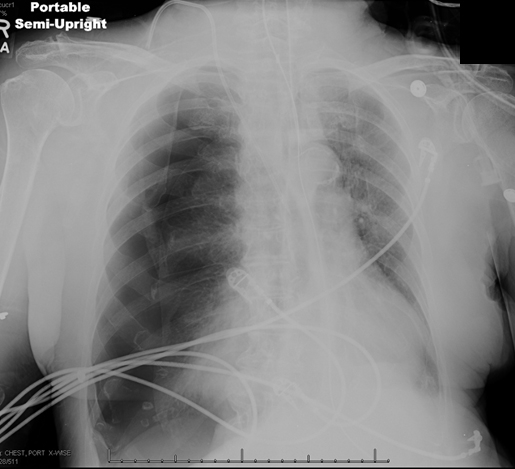
An 85-year-old nursing home resident is brought to the emergency department due to worsening cough, difficulty breathing, and decreased responsiveness for 3 days.  Medical conditions include hypertension, type 2 diabetes mellitus, and dementia.  Following evaluation that reveals leukocytosis and lung infiltrates, the patient's respiratory distress progressively worsens.  Endotracheal intubation is performed; mechanical ventilation is begun; the patient is given intravenous fluids and antibiotics; a central venous catheter is placed; and she is admitted to the intensive care unit (ICU) . In the ICU, the patient requires increasing ventilatory support with elevated airway pressures.  Temperature is 35.6 C (96 F) , blood pressure is 84/40 mm Hg, pulse is 112/min, and respirations are 16/min.  Pulse oximetry shows 92% on assist-control mode with a tidal volume of 300 mL, fraction of inspired oxygen (FiO<sub>2</sub>)  of 60%, and positive end-expiratory pressure (PEEP)  of 5 cm H<sub>2</sub>O.  Examination reveals decreased breath sounds on the right, rhonchi on the left, and normal S1 and S2.  The abdomen is soft and nontender.  There is no extremity edema. Arterial blood gases and chest x-ray are shown below.     Which of the following is the most appropriate next step in management of this patient? A) Increase the PEEP B) Insert chest tube C) Provide short-term neuromuscular paralysis D) Reposition the endotracheal tube E) Suction respiratory secretions An 85-year-old nursing home resident is brought to the emergency department due to worsening cough, difficulty breathing, and decreased responsiveness for 3 days.  Medical conditions include hypertension, type 2 diabetes mellitus, and dementia.  Following evaluation that reveals leukocytosis and lung infiltrates, the patient's respiratory distress progressively worsens.  Endotracheal intubation is performed; mechanical ventilation is begun; the patient is given intravenous fluids and antibiotics; a central venous catheter is placed; and she is admitted to the intensive care unit (ICU) . In the ICU, the patient requires increasing ventilatory support with elevated airway pressures.  Temperature is 35.6 C (96 F) , blood pressure is 84/40 mm Hg, pulse is 112/min, and respirations are 16/min.  Pulse oximetry shows 92% on assist-control mode with a tidal volume of 300 mL, fraction of inspired oxygen (FiO<sub>2</sub>)  of 60%, and positive end-expiratory pressure (PEEP)  of 5 cm H<sub>2</sub>O.  Examination reveals decreased breath sounds on the right, rhonchi on the left, and normal S1 and S2.  The abdomen is soft and nontender.  There is no extremity edema. Arterial blood gases and chest x-ray are shown below.     Which of the following is the most appropriate next step in management of this patient? A) Increase the PEEP B) Insert chest tube C) Provide short-term neuromuscular paralysis D) Reposition the endotracheal tube E) Suction respiratory secretions
Which of the following is the most appropriate next step in management of this patient?


A) Increase the PEEP
B) Insert chest tube
C) Provide short-term neuromuscular paralysis
D) Reposition the endotracheal tube
E) Suction respiratory secretions

Correct Answer:

verifed

Verified

Unlock this answer now
Get Access to more Verified Answers free of charge

Related Questions

Unlock this Answer For Free Now!

View this answer and more for free by performing one of the following actions

qr-code

Scan the QR code to install the App and get 2 free unlocks

upload documents

Unlock quizzes for free by uploading documents