A 75-year-old man with moderate chronic obstructive lung disease is brought to the emergency department with acute onset of dyspnea that started this afternoon. He was discharged 2 days ago for a chronic obstructive pulmonary disease exacerbation treated with short-term noninvasive positive-pressure ventilation, corticosteroids, and antibiotics. He finished the oral antibiotics yesterday and has been nonambulatory since hospital discharge. He also complains of productive cough of whitish sputum and mild right-sided pleuritic chest pain. His other medical problems include hypertension, chronic lower-extremity edema with superficial ulcers, and severe right knee osteoarthritis.
His temperature is 37.2° C (99° F) , blood pressure is 120/73 mm Hg, pulse is 114/min, and respirations are 22/min. Pulse oximetry shows 89% on room air. Jugular venous pressure is estimated at 7 cm H2O. Mild end-expiratory wheezing is heard bilaterally. There is bilateral, chronic-appearing edema of the lower extremities.
Laboratory results are as follows: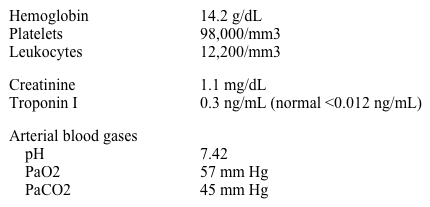
ECG shows sinus tachycardia with nonspecific T-wave changes. Chest x-ray shows hyperinflated lung fields and linear densities at the right lower base consistent with atelectasis.
Which of the following is the best next step in managing this patient?
A) Computed tomography angiography of the chest
B) Intravenous antibiotics and corticosteroids
C) Noninvasive positive ventilation
D) Transthoracic echocardiogram
E) V/Q scan
Correct Answer:

Verified
Q179: A 65-year-old woman comes to the emergency
Q180: A 54-year-old man with a history of
Q181: An 85-year-old nursing home resident is brought
Q182: A 72-year-old man with metastatic prostate cancer
Q183: A 67-year-old man with chronic obstructive pulmonary
Q185: A 67-year-old woman comes to the emergency
Q186: A 62-year-old woman comes to the emergency
Q187: A 46-year-old woman comes to the emergency
Q188: A 28-year-old woman comes to the emergency
Q189: A 62-year-old man comes to the emergency
Unlock this Answer For Free Now!
View this answer and more for free by performing one of the following actions

Scan the QR code to install the App and get 2 free unlocks

Unlock quizzes for free by uploading documents