A 46-year-old woman comes to the emergency department because of progressively worsening shortness of breath, wheezing, dry cough, and sinus pressure for the last 2 weeks. She has had no fever, chills, or night sweats. She has a history of asthma and recurrent sinus infections over the past 10 years. The patient has used albuterol and inhaled corticosteroids for several years, but they no longer seem to help. She also has had joint pains for the last 2 months, for which she takes aspirin as needed.
Other medical conditions include hypertension, gastroesophageal reflux disease, and seasonal allergies. Medications include lisinopril, omeprazole, and loratadine as needed. The patient lives with her husband and has 2 cats. She has not traveled recently. She does not use tobacco, alcohol, or illicit drugs. The patient's father died of an unknown kidney disease, and her mother has a history of diabetes.
Temperature is 36.8 C (98.2 F) , blood pressure is 130/70 mm Hg, pulse is 84/min, and respirations are 16/min. Erythematous tonsils are present without exudates. The patient has bilateral maxillary sinus tenderness to palpation. Bilateral nasal polyps are present. Lung examination reveals diffuse inspiratory and expiratory wheezes. The remainder of the physical examination is unremarkable.
Laboratory results are as follows.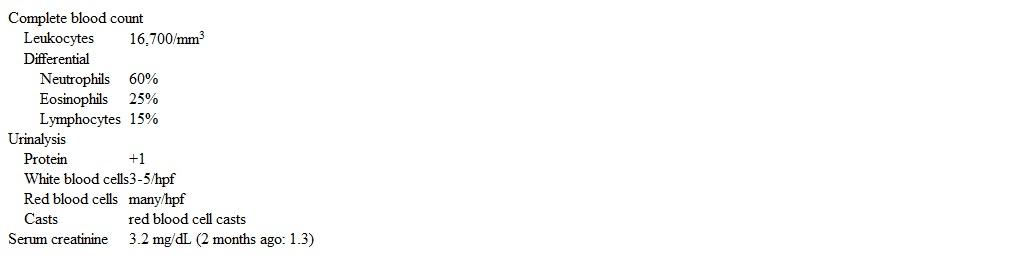 A chest x-ray demonstrates ill-defined opacities bilaterally.
Which of the following is the most likely diagnosis?
A) Allergic bronchopulmonary aspergillosis
B) Aspirin-exacerbated respiratory disease
C) Chronic eosinophilic pneumonia
D) Eosinophilic granulomatosis with polyangiitis
E) Granulomatosis with polyangiitis
Correct Answer:

Verified
Q182: A 72-year-old man with metastatic prostate cancer
Q183: A 67-year-old man with chronic obstructive pulmonary
Q184: A 75-year-old man with moderate chronic obstructive
Q185: A 67-year-old woman comes to the emergency
Q186: A 62-year-old woman comes to the emergency
Q188: A 28-year-old woman comes to the emergency
Q189: A 62-year-old man comes to the emergency
Q190: A 53-year-old man comes to the emergency
Q191: A 62-year-old man comes to the emergency
Q192: A 34-year-old woman comes to the emergency
Unlock this Answer For Free Now!
View this answer and more for free by performing one of the following actions

Scan the QR code to install the App and get 2 free unlocks

Unlock quizzes for free by uploading documents