A 26-year-old woman comes to the office due to a flulike illness with low-grade fever, malaise, nausea, and anorexia. She came back from a trip to Honduras a week ago, and her symptoms started 2 days prior to her return. The patient has no significant medical history and takes no medications. She occasionally smokes marijuana and has used injection drugs in the past. She has had several sexual partners and currently lives with her boyfriend. Temperature is 37.9 C (100.2 F) , blood pressure is 121/78 mm Hg, and pulse is 86/min. The patient has scleral icterus. Cardiopulmonary examination is unremarkable. The liver edge, palpated 4 cm below the right costal margin, is smooth and tender. Laboratory results are as follows: 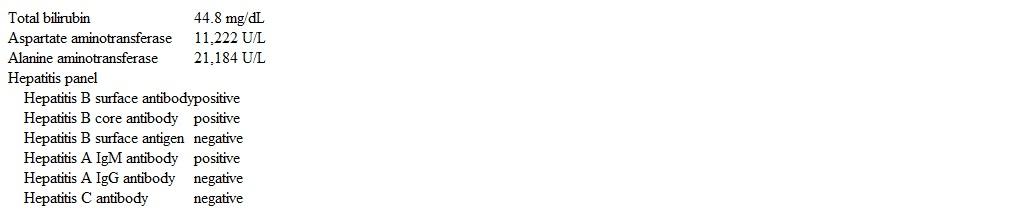 After discussing the findings, the patient says she is worried that she may transmit the disease to her boyfriend. Which of the following interventions for the boyfriend is most likely to decrease his risk of disease acquisition?
A) Barrier contraceptive use
B) Hepatitis A vaccination
C) Hepatitis B immune globulin
D) Hepatitis B vaccination
E) Hepatitis B vaccine and immune globulin
F) No intervention necessary
Correct Answer:

Verified
Q83: A 40-year-old man is evaluated prior to
Q84: A 54-year-old woman comes to the office
Q85: A 39-year-old previously healthy man comes to
Q86: A 36-year-old woman who lives in the
Q87: A 42-year-old man comes to the office
Q89: A 58-year-old man comes to the office
Q90: A 74-year-old man comes to the office
Q91: A 45-year-old man comes to the office
Q92: A 54-year-old man comes to the office
Q93: A 27-year-old woman comes to the office
Unlock this Answer For Free Now!
View this answer and more for free by performing one of the following actions

Scan the QR code to install the App and get 2 free unlocks

Unlock quizzes for free by uploading documents