A 54-year-old man comes to the office due to erectile dysfunction. For the last 6 months, the patient has had progressive difficulty maintaining an erection long enough to have satisfying sexual intercourse. In addition, he has had loss of libido and a decrease in early morning erections. Medical history is significant for hyperlipidemia and coronary artery disease. The patient was admitted for an acute coronary syndrome 7 months ago, and a drug-eluting stent was placed in the right coronary artery. A follow-up treadmill cardiac stress test was negative; he is able to walk briskly for 30 minutes daily without developing angina or other symptoms. Current medications include metoprolol, atorvastatin, aspirin, and ticagrelor. Blood pressure is 122/70 mm Hg and pulse is 66/min. Cardiopulmonary examination is unremarkable except for mildly decreased pedal pulses on the right. He has normal testicular size, normal secondary sexual characteristics, and no gynecomastia. Laboratory results are as follows: 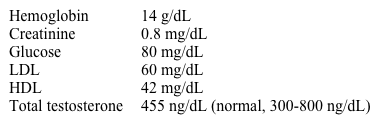 Which of the following is the best next step in treating this patient's erectile dysfunction?
A) Advise the patient to refrain from sexual activity
B) Intraurethral alprostadil
C) Oral sildenafil
D) Stop atorvastatin
E) Stop metoprolol
F) Testosterone therapy
Correct Answer:

Verified
Q87: A 42-year-old man comes to the office
Q88: A 26-year-old woman comes to the office
Q89: A 58-year-old man comes to the office
Q90: A 74-year-old man comes to the office
Q91: A 45-year-old man comes to the office
Q93: A 27-year-old woman comes to the office
Q94: A 28-year-old man comes to the physician
Q95: A 70-year-old man who lives in a
Q96: A 25-year-old man comes to the office
Q97: A 73-year-old man comes to the office
Unlock this Answer For Free Now!
View this answer and more for free by performing one of the following actions

Scan the QR code to install the App and get 2 free unlocks

Unlock quizzes for free by uploading documents