A 31-year-old woman is brought to the emergency department by her boyfriend due to confusion. The boyfriend says that the patient "seemed okay" when he left for work this morning, but when he returned in the evening, she was disoriented and "acting like a drunk person"; she had also vomited "all over the bathroom." The patient was recently fired due to interpersonal problems with other employees. She has a history of bipolar disorder. Medications include clonazepam, lithium, and quetiapine. Temperature is 37 C (98.6 F) , blood pressure is 110/68 mm Hg, pulse is 92/min, and respirations are 16/min. On physical examination, the patient is somnolent and has frequent fasciculations. Pupils are equal and reactive. During evaluation, she has a brief episode of a generalized tonic-clonic seizure. Laboratory results are as follows: 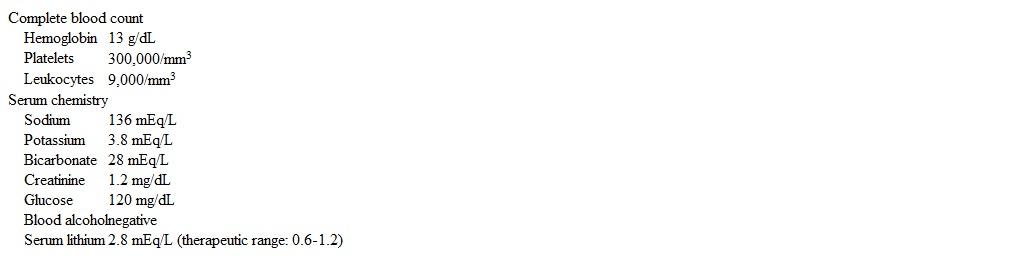 Acetaminophen and salicylate are not detected in the serum, and urine drug screen is negative. A noncontrast CT scan of the head shows no abnormalities. In addition to supportive measures, which of the following is the best next step in management of this patient?
A) Activated charcoal
B) Calcium gluconate
C) Flumazenil
D) Gastric lavage
E) Hemodialysis
F) Magnesium sulfate
G) Physostigmine
Correct Answer:

Verified
Q388: A 67-year-old woman with a past medical
Q389: A 75-year-old woman comes to the emergency
Q390: A 28-year-old woman comes to the emergency
Q391: A 42-year-old prison inmate is brought to
Q392: A 34-year-old man is brought to the
Q394: A 26-year-old woman is brought to the
Q395: A 64-year-old woman comes to the emergency
Q396: A 16-year-old girl is brought to the
Q397: A 23-year-old woman, gravida 1 para 0,
Q398: A 76-year-old woman is being evaluated for
Unlock this Answer For Free Now!
View this answer and more for free by performing one of the following actions

Scan the QR code to install the App and get 2 free unlocks

Unlock quizzes for free by uploading documents