A 27-year-old woman is admitted to the hospital urgently for labor. The patient has had no prenatal care. Delivery is complicated by premature rupture of membranes and prolonged labor. On day 3 of hospitalization, she develops fever, chills, lower abdominal pain, and hypotension. Postpartum endometritis is suspected. The patient is prescribed broad-spectrum antibiotics and intravenous fluids. Over the next 24 hours, she develops increasing shortness of breath. The patient receives a total of 5 L of normal saline to treat the hypotension. Temperature is 38.5 C (101.3 F) , blood pressure is 110/66 mm Hg, pulse is 110/min, and respirations are 24/min. BMI is 34 kg/m2. Pulse oximetry is 80% on a 100% nonrebreather mask, and the decision is made to intubate. There is no evidence of jugular venous distension. Cardiac examination is normal except for tachycardia. Lung auscultation reveals diffuse bilateral crackles. Mild bilateral pitting edema is present in the lower extremities. Chest x-rays 24 hours earlier (left) and at intubation (right) are shown in the images below: 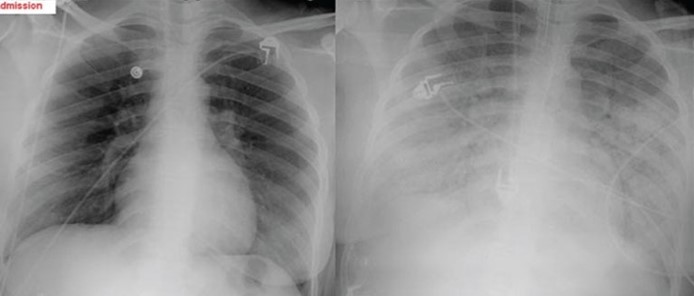 After intubation, an arterial blood gas test shows a PaO2 of 60 mm Hg on 100% oxygen and a PaCO2 of 34 mm Hg. Which of the following best explains this patient's respiratory symptoms?
A) Acute respiratory distress syndrome
B) Diffuse alveolar hemorrhage
C) Hospital-acquired pneumonia
D) Iatrogenic volume overload
E) Postpartum cardiomyopathy
F) Pulmonary thromboembolism
Correct Answer:

Verified
Q791: A 28-year-old woman comes to the office
Q792: A 56-year-old hospitalized man is evaluated for
Q793: A 25-year-old woman, gravida 3 para 0
Q794: A 49-year-old registered nurse comes to the
Q795: A 23-year-old man comes to the clinic
Q797: A 47-year-old man comes to the office
Q798: A 38-year-old man comes to the office
Q799: A 45-year-old woman is brought to the
Q800: A 64-year-old man with a long history
Q801: A prospective cohort study was conducted to
Unlock this Answer For Free Now!
View this answer and more for free by performing one of the following actions

Scan the QR code to install the App and get 2 free unlocks

Unlock quizzes for free by uploading documents