A 65-year-old man comes to the emergency department due to lower extremity swelling and a 9.1-kg (20.1-lb) weight gain over the last month. He also reports some shortness of breath at night. The patient has a history of hypertension and coronary artery disease and underwent coronary artery bypass graft surgery 10 years ago. The patient does not smoke or use recreational drugs. Temperature is 36.7 C (98.1 F) , blood pressure is 140/92 mm Hg, pulse is 98/min, and respirations are 18/min. Examination shows jugular venous distension. Breath sounds are decreased at the bilateral bases. The point of maximal impulse is laterally displaced. S1 and S2 are normal, and a II/VI holosystolic murmur is present at the apex. There is 3+ pretibial edema bilaterally. Laboratory results are as follows: 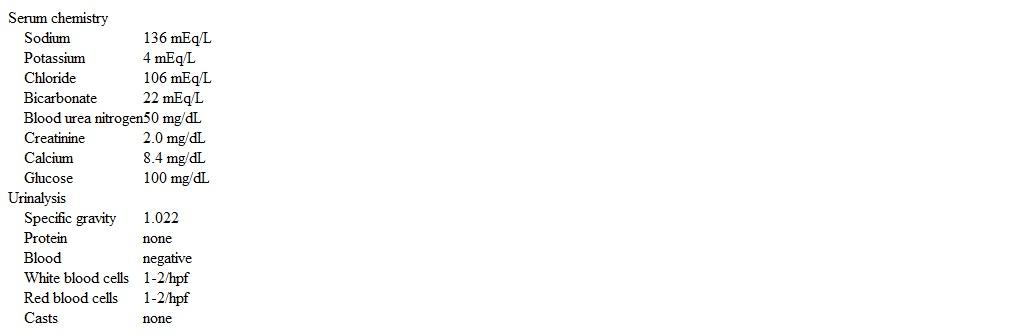 Chest x-ray reveals an enlarged cardiac silhouette and pulmonary vascular congestion. The patient is treated with intravenous furosemide for 4 days, with a return to his baseline weight and resolution of his edema. Serum chemistry shows an improvement in creatinine to 1.1 mg/dL. Which of the following is the most likely mechanism for this improvement in renal function?
A) Decrease in filtration fraction
B) Increase in renal afferent arteriolar resistance
C) Recovery phase of acute tubular necrosis
D) Reduction in renal venous pressure
E) Vasodilation of renal efferent arterioles
Correct Answer:

Verified
Q833: A study was conducted to establish the
Q834: A 56-year-old man comes to the emergency
Q835: A 34-year-old man comes to the office
Q836: A 64-year-old man comes to the emergency
Q837: A 32-year-old man comes to the office
Q839: A 78-year-old man with mild dementia is
Q840: A 60-year-old previously healthy woman is evaluated
Q841: A 60-year-old man comes to the office
Q842: A 64-year-old man with a history of
Q843: An 82-year-old man is evaluated for a
Unlock this Answer For Free Now!
View this answer and more for free by performing one of the following actions

Scan the QR code to install the App and get 2 free unlocks

Unlock quizzes for free by uploading documents