A 60-year-old man is brought to the emergency department due to progressive lethargy. The patient has a history of alcoholic cirrhosis and was recently seen in his primary care provider's office for increasing abdominal distension and leg swelling. His wife says that the swelling improved slightly after furosemide and spironolactone were started, but for the last 2 days he has been confused and irritable. The patient has slept most of the time and has not eaten. Temperature is 36.7 C (98 F) , blood pressure is 96/50 mm Hg, and pulse is 96/min. On examination, the patient appears lethargic but is arousable. He is not very cooperative and at times is agitated. Mucous membranes are dry. His outstretched hands exhibit a flapping tremor. The abdomen is nontender and distended, and shifting dullness is present. Bilateral lower extremity pitting edema is present. Stool occult blood is negative. Laboratory results are as follows: 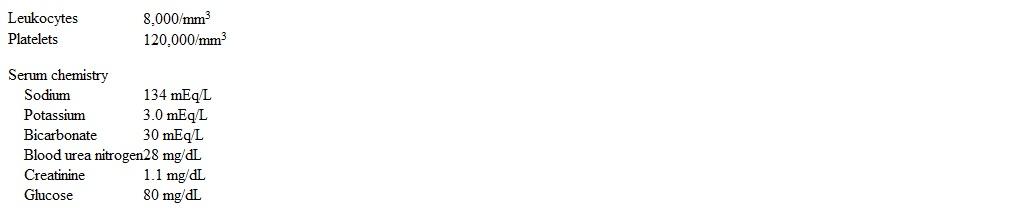 Which of the following is the best initial treatment for this patient?
A) Dietary protein restriction
B) Low-dose lorazepam
C) Oral neomycin
D) Repletion of serum potassium
E) Transjugular intrahepatic portosystemic shunt
Correct Answer:

Verified
Q1120: The patient is started on furosemide and
Q1121: A 26-year-old woman comes to the office
Q1122: A 47-year-old man comes to the emergency
Q1123: A 34-year-old woman comes to the office
Q1124: A 34-year-old man comes to the office
Q1126: A 20-year-old previously healthy woman comes to
Q1127: A 65-year-old woman comes to the office
Q1128: A 75-year-old man is brought to the
Q1129: A 53-year-old woman comes to the urgent
Q1130: A 64-year-old man comes to the emergency
Unlock this Answer For Free Now!
View this answer and more for free by performing one of the following actions

Scan the QR code to install the App and get 2 free unlocks

Unlock quizzes for free by uploading documents