A 68-year-old woman comes to the emergency department due to severe generalized weakness and dizziness. She has not fallen or lost consciousness. The patient reports no chest pain, dyspnea, cough, or diarrhea; however, she has had worsening fatigue, nausea, and anorexia for the past 3 weeks. The patient has a history of breast cancer treated with surgery and chemotherapy 5 years ago but was found to have a vertebral metastatic lesion during evaluation of back pain a month ago. Radiation therapy and systemic chemotherapy are planned, but she has not received treatment yet. The patient has no other medical conditions, and the only prescribed medication is opioid analgesic as needed. Temperature is 37.5 C (99.5 F) , blood pressure is 108/66 mm Hg, and pulse is 102/min. Orthostatic changes are present and oral mucosa are dry. The lungs are clear on auscultation and heart sounds are normal. The abdomen is soft with mild generalized tenderness, and no lower extremity edema is present. There is focal tenderness of the mid thoracic vertebrae with no focal neurologic deficit. Laboratory results are as follows: 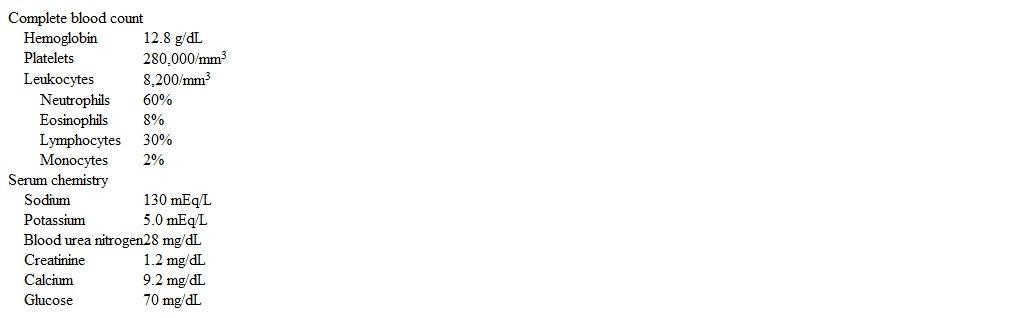 In addition to intravenous fluids, which of the following is the most appropriate management of this patient?
A) Appetite stimulant and nutritional supplements
B) Blood culture and empiric antibiotics
C) Cosyntropin stimulation testing
D) Discontinuation of opioid analgesics
E) Percutaneous gastrostomy tube placement
Correct Answer:

Verified
Q1171: A 29-year-old man comes to the emergency
Q1172: A 32-year-old man comes to the emergency
Q1173: A 41-year-old man comes to the office
Q1174: A 42-year-old mildly overweight man is being
Q1175: A 64-year-old woman comes to the emergency
Q1177: A 57-year-old woman receiving chemotherapy for stage
Q1178: A 62-year-old man comes to the physician
Q1179: A 55-year-old man comes to the office
Q1180: A 65-year-old man is brought to the
Q1181: A 27-year-old man comes to the emergency
Unlock this Answer For Free Now!
View this answer and more for free by performing one of the following actions

Scan the QR code to install the App and get 2 free unlocks

Unlock quizzes for free by uploading documents