A 65-year-old man is brought to the emergency department due to high fevers and confusion. He has had 2 days of cough productive of greenish sputum. He has a history of well-controlled type 2 diabetes mellitus and was treated for bronchitis twice in the last 4 months. The patient received the influenza vaccine this year. He has smoked a pack of cigarettes daily for the past 27 years and drinks alcohol occasionally. Temperature is 38.4 C (101.2 F) , blood pressure is 118/74 mm Hg, pulse is 98/min, and respirations are 24/min. His pulse oximetry reading is 92% on room air. The patient is obese. His anterior cervical lymph nodes are enlarged and nonpainful. His lungs are clear to auscultation except for scattered rales at the right lung base. Abdominal examination reveals a palpable liver edge and spleen tip. Chest-x ray shows a developing right lower lobe infiltrate. Laboratory studies are as follows: 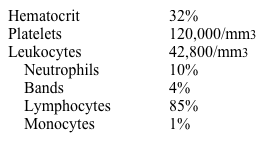 Blood cultures are sent to the laboratory; antibiotics and supportive care are initiated. What is the best next step in management of this patient?
A) Bronchoscopy
B) Epstein-Barr virus serology
C) Flow cytometry of the peripheral blood
D) JAK2 mutation testing
E) Lymph node biopsy
F) Serum protein electrophoresis
Correct Answer:

Verified
Q1175: A 64-year-old woman comes to the emergency
Q1176: A 68-year-old woman comes to the emergency
Q1177: A 57-year-old woman receiving chemotherapy for stage
Q1178: A 62-year-old man comes to the physician
Q1179: A 55-year-old man comes to the office
Q1181: A 27-year-old man comes to the emergency
Q1182: A 17-year-old boy comes to the office
Q1183: A 55-year-old woman comes to the office
Q1184: A 42-year-old woman is evaluated for chronic
Q1185: A 34-year-old male is brought to the
Unlock this Answer For Free Now!
View this answer and more for free by performing one of the following actions

Scan the QR code to install the App and get 2 free unlocks

Unlock quizzes for free by uploading documents