A 28-year-old woman comes to the emergency department due to bilateral upper extremity weakness and abdominal pain. The patient has had progressive weakness of the upper extremities for 2 days and severe, diffuse, poorly localized abdominal pain for 1 day. Temperature is 37.3 C (99.1 F) , blood pressure is 148/86 mm Hg, and pulse is 112/min. On physical examination, the patient appears restless and is diaphoretic. There is no scleral icterus. The abdomen is soft and nontender, with no organomegaly, guarding, or rebound tenderness. Bowel sounds are decreased. Neurological examination shows normal cranial nerves, weakness of the proximal upper extremity muscles, and loss of the biceps and triceps reflexes on both sides. Laboratory results are as follows: 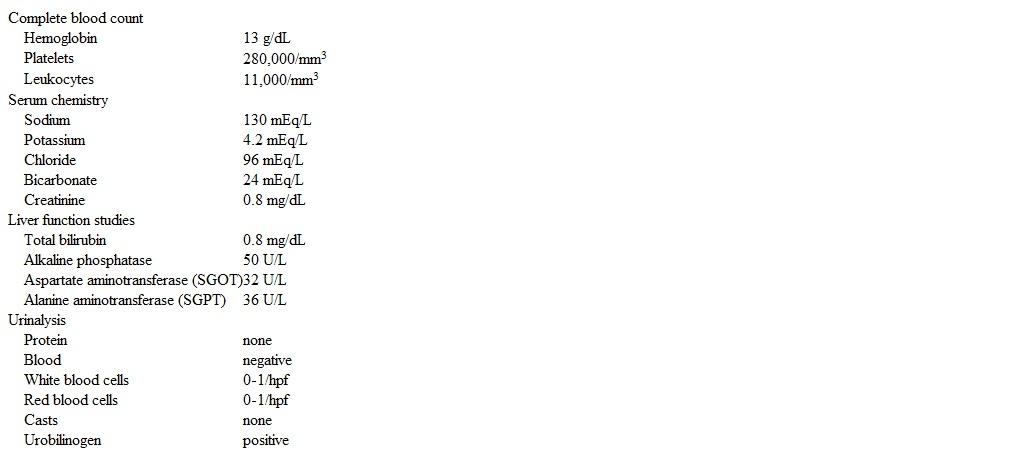 Which of the following is most likely to yield the diagnosis in this patient?
A) Blood lead concentration
B) Cerebrospinal fluid analysis
C) Genetic testing for JAK2 mutation
D) Mesenteric angiography
E) Serum ceruloplasmin level
F) Urinary porphyrin level
Correct Answer:

Verified
Q1639: A 45-year-old previously healthy man is brought
Q1640: A 74-year-old woman comes to the emergency
Q1641: An 18-year-old man is on mechanical ventilation
Q1642: A 35-year-old man comes to the office
Q1643: A 60-year-old man comes to the office
Q1645: A 35-year-old man comes to the emergency
Q1646: A 35-year-old man is brought to the
Q1647: A 74-year-old woman is brought to the
Q1648: A 63-year-old man comes to the emergency
Q1649: A 68-year-old woman comes to the office
Unlock this Answer For Free Now!
View this answer and more for free by performing one of the following actions

Scan the QR code to install the App and get 2 free unlocks

Unlock quizzes for free by uploading documents