A 32-year-old woman, gravida 2 para 1, comes to the office for a routine prenatal visit. The patient had a postpartum hemorrhage (PPH) after her first pregnancy and is worried about the possibility of PPH after her scheduled repeat cesarean delivery. She read about the effectiveness of prophylactic tranexamic acid in reducing the risk of hemorrhage after scheduled cesarean delivery and wants to discuss the results. The outcomes of the study were PPH, clinical and laboratory (blood samples at day 2) measurements of postpartum blood loss, and several adverse events after scheduled cesarean delivery at ≥34 weeks gestation. Patients received intravenous infusion of a uterotonic agent and either tranexamic acid or saline placebo within 3 minutes after cesarean delivery. A summary of the results is shown in the table below. 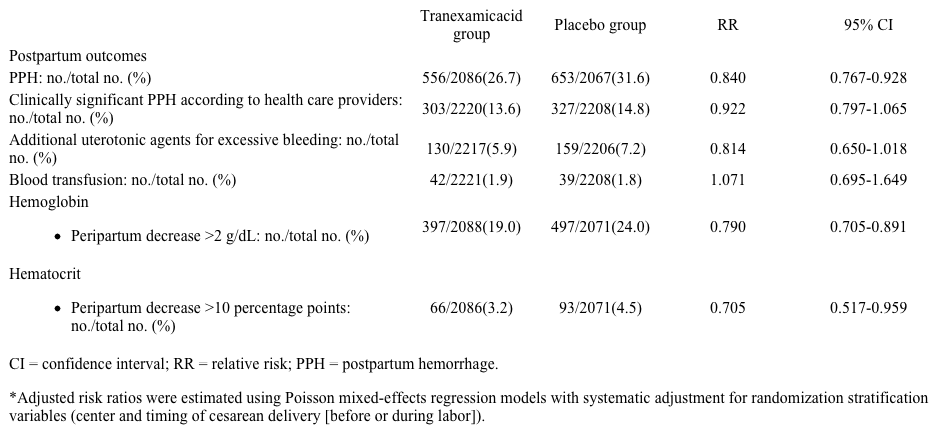 Based on the study results, which of the following conclusions is strongly justified?
A) Tranexamic acid is associated with an increased risk of blood transfusions
B) Tranexamic acid significantly reduced the risk of all postpartum study outcomes except the need for blood transfusions
C) The risk of peripartum hemoglobin decrease >2 g/dL is about 80% lower in the tranexamic acid group compared to the placebo group
D) The risk of PPH is significantly reduced by 16% when tranexamic acid is used as a prophylactic compared to placebo
E) There is no significant difference in postpartum outcomes between treatment groups
Correct Answer:

Verified
Q22: An 84-year-old man comes to the physician
Q23: A retrospective, matched-cohort study is conducted to
Q24: An 84-year-old man comes to the physician
Q25: A 35-year-old man comes to the emergency
Q26: A study was conducted to identify factors
Q28: A 59-year-old man comes to the office
Q29: A new, randomized, placebo-controlled trial studied the
Q30: A study examines the role of different
Q31: A 69-year-old man with chronic kidney disease
Q32: A randomized controlled trial is conducted to
Unlock this Answer For Free Now!
View this answer and more for free by performing one of the following actions

Scan the QR code to install the App and get 2 free unlocks

Unlock quizzes for free by uploading documents