A 72-year-old man comes to the emergency department due to progressive shortness of breath and cough productive of yellowish sputum. The patient says, "I have been feeling breathless for the past several months while mowing the lawn or walking around the house, but it has been worse over the last 3 days." He has had no chest pain or leg swelling but notes that his heart "has been racing." The patient has a history of hypertension, peptic ulcer disease, and osteoarthritis. He was hospitalized for pneumonia a year ago and required intravenous antibiotics. Six months ago, the patient underwent a cardiac stress test for chest discomfort, which was unremarkable. The patient has smoked a pack of cigarettes daily for 45 years. Blood pressure is 160/90 mm Hg, pulse is 148/min, and respirations are 26/min. He is speaking in partial sentences and using accessory muscles of respiration but is alert and cooperative. There is no jugular venous distension or heart murmurs, rub, or gallops, but the heart sounds are irregular. Lung auscultation reveals bilateral rhonchi and expiratory wheezes. Arterial blood gases while breathing 2 L of oxygen via nasal cannula reveal PO2 of 66 mm Hg, PCO2 of 52 mm Hg, and pH 7.33. ECG shows narrow QRS complexes with distinct P waves of different morphologies and variable PR segments and R-R intervals. Chest x-ray reveals no pulmonary infiltrates or consolidation. Inhaled bronchodilators and systemic glucocorticoids are administered. The patient's dyspnea has improved after initial treatment in the emergency department, but he continues to have palpitations. Pulse is 125/min and irregular. Blood pressure is 140/88 mm Hg and respirations are 16/min. Oxygen saturation is 92% on 2 L oxygen via nasal cannula. ECG findings are unchanged from the time of admission. Laboratory results are as follows: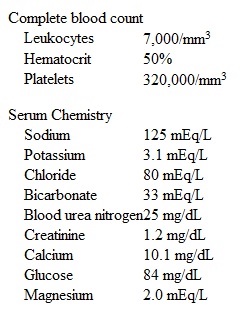 Which of the following is the most appropriate next step in management of this patient?
A) Hypertonic saline
B) Intravenous esmolol
C) Intravenous verapamil
D) Potassium replacement
E) Unfractionated heparin infusion
Correct Answer:

Verified
Q84: A 70-year-old woman is brought to the
Q85: A 52-year-old woman comes to the emergency
Q86: A 72-year-old man is brought to the
Q87: An 8-year-old girl is brought to the
Q88: A 55-year-old woman comes to the office
Q90: A 28-year-old woman comes to the office
Q91: A 70-year-old woman is brought to the
Q92: A 31-year-old man comes to the physician
Q93: A 12-year-old boy is brought to the
Q94: A 70-year-old man comes to the hospital
Unlock this Answer For Free Now!
View this answer and more for free by performing one of the following actions

Scan the QR code to install the App and get 2 free unlocks

Unlock quizzes for free by uploading documents