A 72-year-old man comes to a rural health clinic due to intermittent leg pain. The patient reports a dull discomfort in his left lower calf with activity, causing him to stop and rest on the way to his mailbox, which is approximately 150 m (492 ft) from his house. The pain improves with rest and does not occur at night when he is lying in bed. Medical history is significant for hypertension and gout. Current medications include lisinopril and allopurinol. The patient has a 40-pack-year smoking history, but quit 5 years ago. Family history is significant for a stroke in his father and breast cancer in his mother. Blood pressure is 130/78 mm Hg and pulse is 75/min. The patient's left foot is shiny and devoid of hair, but there are no lower extremity ulcerations. Strength and sensory examination of the left lower extremity is normal. The ankle-brachial index is 0.76 on the left and 1.05 on the right (normal: 1.0-1.4) . Laboratory results are as follows: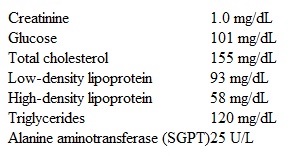 Following medication adjustment, the patient is sent for CT angiography that shows 90% stenosis of the left superficial femoral artery and 80% stenosis of the left popliteal artery. Which of the following is the best additional recommendation for this patient?
A) Intermittent pneumatic compression
B) Low-fat diet
C) Percutaneous stent placement
D) Supervised exercise program
E) Surgical bypass grafting
Correct Answer:

Verified
Q109: A 42-year-old man is brought to the
Q110: A 54-year-old man is brought by his
Q111: A 56-year-old man comes to the physician
Q112: A 29-year-old man comes to the emergency
Q113: A 42-year-old man comes to the office
Q115: A 53-year-old man comes to the office
Q116: A 62-year-old man is brought to the
Q117: A 72-year-old man with diet-controlled diabetes mellitus
Q118: An 82-year-old woman comes to the emergency
Q119: A 58-year-old woman comes to the physician
Unlock this Answer For Free Now!
View this answer and more for free by performing one of the following actions

Scan the QR code to install the App and get 2 free unlocks

Unlock quizzes for free by uploading documents