A 68-year-old man is brought to the emergency department by his daughter due to confusion and lethargy. The patient's daughter reports that he lives alone and has type 2 diabetes mellitus and hypertension. He takes aspirin, enalapril, and glipizide. He is afebrile. Blood pressure is 99/59 mm Hg, pulse is 132/min, and respirations are 22/min. The patient appears drowsy and is barely communicative. Examination shows dry mucous membranes, absent jugular venous distention, clear lung fields, and normal heart sounds. The abdomen is soft, nontender, and nondistended. Neurologic examination shows disorientation to time and place. The patient moves all extremities and examination shows no meningeal signs. Laboratory results are as follows: 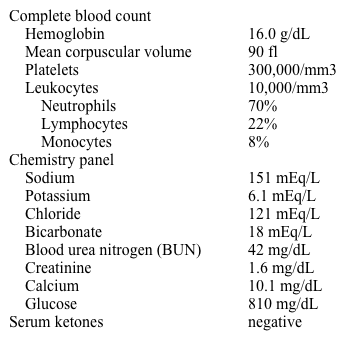 An ECG shows atrial fibrillation with a rapid ventricular response. Nonspecific T wave changes are present. Which of the following is the best initial approach to managing this patient?
A) Correction of hyperkalemia
B) High-dose insulin therapy
C) Rate control of atrial fibrillation
D) Rhythm control of atrial fibrillation
E) Volume resuscitation
Correct Answer:

Verified
Q241: A 56-year-old woman was found to have
Q242: A 66-year-old man is found to have
Q243: An 83-year-old woman with mild cognitive impairment
Q244: A 67-year-old man comes for follow-up of
Q245: A 25-year-old man comes to the office
Q247: A 34-year-old woman comes to the physician
Q248: A 47-year-old man comes to the office
Q249: A 29-year-old woman, gravida 1 para 0,
Q250: A 33-year-old woman comes to the office
Q251: A 26-year-old woman, gravida 1 para 0,
Unlock this Answer For Free Now!
View this answer and more for free by performing one of the following actions

Scan the QR code to install the App and get 2 free unlocks

Unlock quizzes for free by uploading documents