A 25-year-old man comes to the office with a 2-month history of fatigue, palpitations, sweating, and heat intolerance. The symptoms are becoming more distressing and are keeping the patient awake at night. The patient has no diplopia, eye pain or redness, decreased vision, neck pain, or proximal muscle weakness. Medical history is unremarkable, and he currently takes no medications. He smoked for approximately a year during college but quit after graduation. The patient drinks alcohol socially but does not use recreational drugs. Family history is positive for hypothyroidism in his mother. Temperature is 36.7 C (98 F) , blood pressure is 130/70 mm Hg, pulse is 115/min (regular) , and respirations are 18/min. Examination shows an anxious, thin man in no acute distress. There is mild lid lag but no conjunctival erythema or proptosis. Extraocular movements and pupillary reflexes are intact. Mild diffuse nontender enlargement of the thyroid gland is noted. The skin is warm and moist. Cardiac examination is unremarkable except for tachycardia. Neurologic examination shows a fine hand tremor and brisk symmetrical reflexes but is otherwise unremarkable. Laboratory tests show normal complete blood count, basic metabolic profile, and urinalysis. Thyroid function test results are as follows: 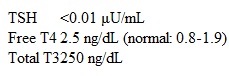 Radioactive iodine uptake at 24 hours is 36% (normal: 8%-25%) , and scan shows a diffuse uptake pattern. Serum thyroid-stimulating immunoglobulin level is mildly elevated. Treatment options are explained to the patient. Six weeks later, he returns to the office and says that his symptoms have resolved. Blood pressure is 120/80 mm Hg and pulse is 82/min. Eye examination reveals no lid lag. The thyroid examination is unchanged, and the rest of the examination is unremarkable. Which of the following tests is most likely to be helpful in this patient?
A) Complete blood count
B) Liver function tests
C) Thyroid-stimulating immunoglobulin level
D) Total T3 and free T4 levels
E) TSH level
Correct Answer:

Verified
Q240: A 40-year-old man comes to the office
Q241: A 56-year-old woman was found to have
Q242: A 66-year-old man is found to have
Q243: An 83-year-old woman with mild cognitive impairment
Q244: A 67-year-old man comes for follow-up of
Q246: A 68-year-old man is brought to the
Q247: A 34-year-old woman comes to the physician
Q248: A 47-year-old man comes to the office
Q249: A 29-year-old woman, gravida 1 para 0,
Q250: A 33-year-old woman comes to the office
Unlock this Answer For Free Now!
View this answer and more for free by performing one of the following actions

Scan the QR code to install the App and get 2 free unlocks

Unlock quizzes for free by uploading documents