A 40-year-old man comes to the office for follow-up of type 1 diabetes mellitus. He was diagnosed 3 years ago when he was admitted to the hospital for diabetic ketoacidosis. The diabetes is treated with a continuous subcutaneous insulin infusion via an insulin pump, and most blood glucose levels are within 80-120 mg/dL with no significant hypoglycemic episodes. The patient exercises 5 days a week and follows strict dietary restrictions; he has avoided eating "junk food" apart from a small slice of cake on his birthday 3 months ago. Medical history is notable only for mild vitiligo, and his only other medication is a daily multivitamin. The patient does not use tobacco, alcohol, or illicit drugs. Family history is negative for diabetes mellitus and premature coronary artery disease. Blood pressure is 126/80 mm Hg and pulse is 68/min. BMI is 23.4 kg/m2. Physical examination, including lower extremity monofilament testing, is normal. Laboratory results are as follows: 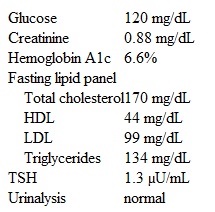 Which of the following is the best next step in management of this patient's condition?
A) Continue current therapy
B) Initiate statin therapy
C) Screen for diabetic retinopathy
D) Start an ACE inhibitor
E) Start low-dose aspirin therapy
Correct Answer:

Verified
Q235: A 72-year-old woman is brought to the
Q236: A 58-year-old woman comes to the office
Q237: A 28-year-old woman with type 1 diabetes
Q238: A 63-year-old man comes to the office
Q239: A 6-month-old girl is brought to the
Q241: A 56-year-old woman was found to have
Q242: A 66-year-old man is found to have
Q243: An 83-year-old woman with mild cognitive impairment
Q244: A 67-year-old man comes for follow-up of
Q245: A 25-year-old man comes to the office
Unlock this Answer For Free Now!
View this answer and more for free by performing one of the following actions

Scan the QR code to install the App and get 2 free unlocks

Unlock quizzes for free by uploading documents