Passage
Neurulation refers to the early formation of the nervous system in vertebrate embryos and begins when the notochord, a rodlike mesodermal structure, induces neural tube and neural crest cell formation in the ectoderm. Neural tube defects (NTDs) arise from abnormalities in the development of the neural tube and can range from mild to severe, depending on which portion of the tube is affected. Spina bifida, a form of NTD, is divided into three categories. The most serious subclassification of spina bifida is myelomeningocele, which occurs when the lower spine fails to close, which leaves the spinal cord and nerve roots in the lower back damaged and exposed.NTDs are thought to be caused in part by folate deficiency. Folate plays a critical role in normal cell division and growth as it is a necessary coenzyme for DNA synthesis and methylation. Mutations in several genes involved in folate metabolism have been associated with an increased risk for NTDs. It has been hypothesized that folate decreases NTD risk by ameliorating oxidative stress, thereby reducing damage to developing cells in the embryo. Certain maternal conditions, such as high blood glucose, increase the risk of NTD development by enhancing embryonic oxidative stress during crucial developmental periods.A study was conducted to examine how supplementation with folic acid, the dietary form of folate, affected pregnant women who were identified to have preexisting diabetes, pregestational obesity (another risk factor for NTD) , or no preexisting conditions (control group) . Higher folic acid intake decreased the incidence of embryonic NTDs among pregnant women with diabetes, but no significant effect was found for pregnant women who were obese.
Adapted from Parker SE, Yazdy MM, Tinker SC, Mitchell AA, Werler MM. The impact of folic acid intake on the association among diabetes mellitus, obesity, and spina bifida. Am J Obstet Gynecol. 2013;209(3) :239.e1-8.
-In vertebrates, researchers found that the concentration pattern of the signaling proteins Sonic Hedgehog (Shh) and Bone Morphogenic Protein (BMP) defined specific regions of expression for various genes involved in neural tube development. The results of their investigation are shown in the graph provided. 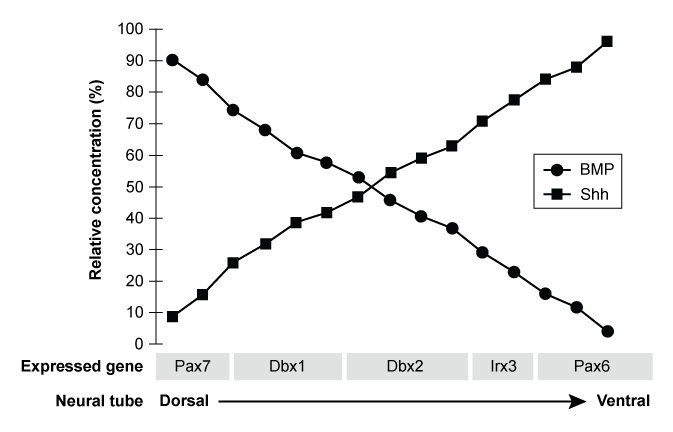 Based on the data, which statement best explains how Shh specifies the dorsal and ventral fates of the developing neural tube?
A) Shh influences the expression of genes necessary for cell division.
B) Shh diffuses along a concentration gradient to signal cell differentiation.
C) Shh signals for development of the ventral neural tube only.
D) Shh acts as a receptor for BMP in the developing neural tube.
Correct Answer:

Verified
Q123: Passage
Parathyroid hormone (PTH) is an important regulator
Q124: Passage
Domestic pigs have been used as valuable
Q125: Passage
Neurulation refers to the early formation of
Q126: Passage
Osteoarthritis (OA) is a disorder marked by
Q127: Passage
Neurulation refers to the early formation of
Q129: Passage
Osteoarthritis (OA) is a disorder marked by
Q130: Passage
Parathyroid hormone (PTH) is an important regulator
Q131: Passage
Osteoarthritis (OA) is a disorder marked by
Q132: Passage
Neurulation refers to the early formation of
Q133: Passage
Neurulation refers to the early formation of
Unlock this Answer For Free Now!
View this answer and more for free by performing one of the following actions

Scan the QR code to install the App and get 2 free unlocks

Unlock quizzes for free by uploading documents