Passage
Osteoarthritis (OA) is a disorder marked by the deterioration of articular (hyaline) cartilage, the connective tissue lining the ends of bones at most movable joints. The progressive erosion of articular cartilage in OA is thought to be caused by an inflammatory response induced by years of biomechanical stress due to excessive compression and friction. This response involves the release of proteolytic enzymes that break down cartilaginous proteins. The progressive breakdown of articular cartilage ultimately results in complete exposure of the cortical portion of the underlying subchondral bone with narrowing of the joint space. Repeated and abnormal joint stress can also cause the development of osteophytes, or bony growths, that form on the subchondral bone. These degenerative processes cause pain and restrict joint movement.Stem cell therapy, in which injected or grafted stem cells are induced to differentiate into chondrocytes (cartilage cells) , is a potential new treatment for OA. To further understand chondrogenesis, researchers have been studying the molecules that regulate the expression and activity of the transcription factor Sox9, which has been shown to promote chondrocyte differentiation. For example, researchers have found that binding of the growth factor TGF-β to its receptor results in Sox9 activation.MicroRNAs (miRNAs) , which are known to alter gene expression by acting at the translational level, are also potential regulators of Sox9. In particular, miRNA-145 is thought to regulate Sox9 expression by binding to the 3′-UTR of the Sox9 mRNA transcript. After chondrocyte differentiation was induced using TGF-β, researchers used Western blotting to generate an expression profile of Sox9 and β-actin (a protein not regulated by miRNA-145) in mouse stem cells transfected with miRNA-145, anti-miRNA-145, or neither (Figure 1) .
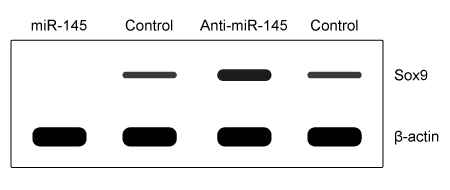 Figure 1 Expression of Sox9 in the presence and absence of miRNA-145 or anti-miRNA-145 following induction of chondrocyte differentiation
Adapted from Yang B, Guo H, Zhang Y, Chen L, Ying D, Dong S. MicroRNA-145 regulates chondrogenic differentiation of mesenchymal stem cells by targeting Sox9. PLoS ONE. 2011;6(7) :e21679.
-Microscopic examination of tissue samples obtained from the type of bone that becomes exposed in advanced OA is most likely to reveal all of the following EXCEPT:
A) Volkmann canals connecting haversian canals.
B) mature chondrocytes.
C) canaliculi.
D) osteocytes situated within lacunae.
Correct Answer:

Verified
Q124: Passage
Domestic pigs have been used as valuable
Q125: Passage
Neurulation refers to the early formation of
Q126: Passage
Osteoarthritis (OA) is a disorder marked by
Q127: Passage
Neurulation refers to the early formation of
Q128: Passage
Neurulation refers to the early formation of
Q130: Passage
Parathyroid hormone (PTH) is an important regulator
Q131: Passage
Osteoarthritis (OA) is a disorder marked by
Q132: Passage
Neurulation refers to the early formation of
Q133: Passage
Neurulation refers to the early formation of
Q134: Passage
Domestic pigs have been used as valuable
Unlock this Answer For Free Now!
View this answer and more for free by performing one of the following actions

Scan the QR code to install the App and get 2 free unlocks

Unlock quizzes for free by uploading documents