Passage
Bone remodeling is the continuous, microscopic process by which bone tissue throughout the body is resorbed and re-deposited. Proper regulation of bone remodeling is necessary to maintain bone strength and prevent the onset of conditions of fragile bone such as osteoporosis. Patients with such conditions have increased fracture risk and generally exhibit decreased activity of osteoblasts (bone-depositing cells) , leading to reduced bone density and weakening of the bone matrix. However, some cases can occur due to overactive osteoclasts (multinucleated cells that mediate bone resorption) . Osteoclasts resorb bone by secreting proteolytic enzymes and acids into the adjacent extracellular space. These enzymes degrade the organic matrix of bone, and the acid causes the dissolution and release of the mineral components of bone, such as calcium, potassium, and magnesium. Generally, less than 1% of adult bone is occupied by active osteoclasts.Osteoclast differentiation and activation is thought to be related to the RANK/RANKL signaling pathway. RANKL, expressed as a membrane-bound or secreted protein, serves as the ligand for RANK, a transmembrane receptor. In bone tissue, RANK is expressed by precursors of mature osteoclasts, also known as osteoclast progenitor cells (OPCs) . RANKL is expressed by osteoblasts adjacent to OPCs, and the binding of RANKL to RANK in these neighboring cells causes downstream effects through recruitment of TRAF6, an intracellular protein. TRAF6 activates multiple downstream signaling cascades, but only four of these directly mediate the development of mature osteoclasts from OPCs. In one of the four pathways, the transcription factor NF-kB is activated, which leads to increased expression of the proto-oncogene c-Fos. Subsequently, c-Fos interacts with another transcription factor known as NFATc to promote the expression of genes related to osteoclast-specific development and function in OPCs (Figure 1) .
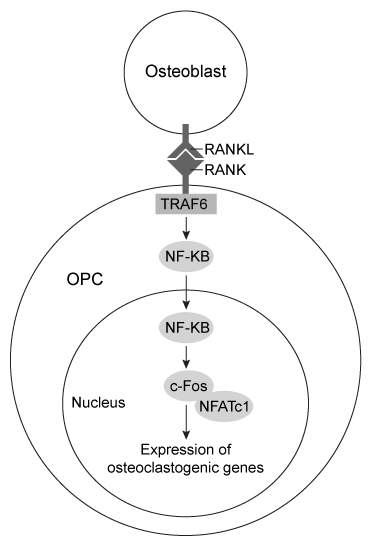 Figure 1 RANK/RANKL signaling induces differentiation of OPCs into osteoclasts
-Based on the passage, the cells that are most important for the differentiation of OPCs are cells that promote:
A) calcium transfer from bone tissue into the bloodstream.
B) calcium transfer from the bloodstream into bone tissue.
C) acid production in bone tissue.
D) proteolytic enzyme production in bone tissue.
Correct Answer:

Verified
Q228: Passage
Endometriosis is a chronic, treatable disease of
Q229: Passage
The sex chromosomes X and Y are
Q230: Passage
Endometriosis is a chronic, treatable disease of
Q231: Passage
Bone remodeling is the continuous, microscopic process
Q232: Passage
The sex chromosomes X and Y are
Q234: Passage
The adrenal glands are divided into two
Q235: Passage
The adrenal glands are divided into two
Q236: Passage
Endometriosis is a chronic, treatable disease of
Q237: Passage
Endometriosis is a chronic, treatable disease of
Q238: Passage
Bone remodeling is the continuous, microscopic process
Unlock this Answer For Free Now!
View this answer and more for free by performing one of the following actions

Scan the QR code to install the App and get 2 free unlocks

Unlock quizzes for free by uploading documents