Passage
Endometriosis is a chronic, treatable disease of the female reproductive tract associated with infertility and pelvic pain in women of reproductive age. The endometrium, a layer of epithelial tissue that grows and sheds during the menstrual cycle, normally makes up the interior lining of the uterus. In individuals with endometriosis, endometrial tissue is also found ectopically (outside the uterine cavity) .The mechanism by which endometrial tissue successfully implants outside the uterine cavity is thought to be dependent on signaling molecules that promote the formation of blood vessels locally. One of these signaling molecules is vascular endothelial growth factor (VEGF) , a protein that is normally synthesized and secreted by various tissues in response to reduced oxygen levels. Because VEGF is thought to be implicated in ectopic endometrial tissue growth, researchers hypothesize that the abdominal and pelvic structures of women with endometriosis would contain higher levels of VEGF compared to women without endometriosis.In an experiment, women ages 25-40 were divided into groups based on endometriosis disease status. Individuals on any type of medication were excluded from the study. Using minimally invasive surgery, samples of peritoneal fluid were taken from healthy subjects (n = 19) and from subjects diagnosed with endometriosis (n = 30) . An enzyme-linked immunosorbent assay (ELISA) was used to characterize the concentration of VEGF protein present within these samples.In a separate procedure that took place five days after peritoneal fluid collection, uterine endometrial samples were obtained from all subjects and visualized under a microscope to determine the menstrual cycle phase of each participant. Figure 1 shows the level of VEGF in the abdominal fluid categorized by disease status and menstrual cycle phase.
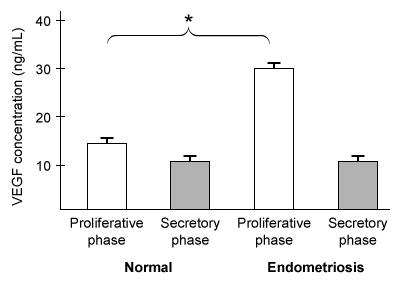 Figure 1 VEGF concentration in sampled peritoneal fluid (Note: * = p < 0.05; Proliferative phase = stage immediately preceding ovulation; Secretory phase = stage immediately following ovulation)
-Surgical removal of the ovaries is one treatment for endometriosis. Complete removal of the ovaries would most likely result in which of the following?
A) Significant increase in bone mass
B) Degeneration of breast tissue
C) Severe immune system impairment
D) Increased frequency of menstruation
Correct Answer:

Verified
Q225: The DNA of telomeres can be most
Q226: Passage
The sex chromosomes X and Y are
Q227: Passage
The adrenal glands are divided into two
Q228: Passage
Endometriosis is a chronic, treatable disease of
Q229: Passage
The sex chromosomes X and Y are
Q231: Passage
Bone remodeling is the continuous, microscopic process
Q232: Passage
The sex chromosomes X and Y are
Q233: Passage
Bone remodeling is the continuous, microscopic process
Q234: Passage
The adrenal glands are divided into two
Q235: Passage
The adrenal glands are divided into two
Unlock this Answer For Free Now!
View this answer and more for free by performing one of the following actions

Scan the QR code to install the App and get 2 free unlocks

Unlock quizzes for free by uploading documents