Passage
An automated external defibrillator (AED) is a medical device used to send an electric shock to the heart after cardiac arrest. A key component of the AED is the power source, or battery. Batteries used in AEDs need to have a good charge-to-weight ratio; they must be safe and reliable as well as rechargeable.Two types of rechargeable batteries used in early models of AEDs are the lead storage (also called lead-acid) battery and the nickel-cadmium (NiCd) battery. These batteries consist of multiple electrochemical cells that are connected in series to deliver a potential between 9 V and 18 V. A capacitor allows the AED to accumulate charge so that it can deliver between 300 V and 1,000 V.Some AEDs use a sealed lead storage battery. Lead storage batteries are robust and hold a charge for a long time. However, they have a low energy-to-weight ratio. Each lead storage cell delivers approximately 2.0 V, and a battery of four cells weighing 1000 g can provide 30 W∙h of energy.
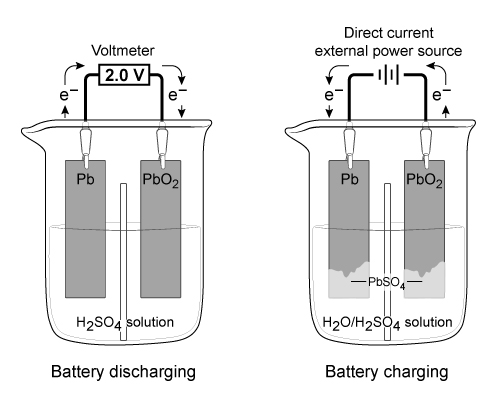 Figure 1 Electron flow in a lead storage battery when discharging and chargingThe half reactions for the anode and cathode of a lead storage battery in 4 M of sulfuric acid (H2SO4) are shown in Reactions 1 and 2:
 Reaction 1
 Reaction 2
NiCd batteries have a higher energy-to-weight ratio than lead storage batteries but cannot hold as much charge. Each NiCd cell delivers approximately 1.3 V, and a single-cell battery weighing 120 g can provide 7.2 W∙h of energy.The half reactions at the anode and cathode for a NiCd battery in KOH are shown in Reactions 3 and 4:
 Reaction 3
 Reaction 4
-To charge the NiCd cell, the applied external potential must be:
A) equal to 1.3 V.
B) greater than 1.3 V.
C) equal to −1.3 V.
D) less than −1.3 V.
Correct Answer:

Verified
Q75: Passage
Household cleaners commonly contain either ammonia (NH3)
Q76: Passage
Kidney stones are a common ailment affecting
Q77: Passage
Combustion occurs when an oxidation-reduction reaction takes
Q78: Passage
Combustion occurs when an oxidation-reduction reaction takes
Q79: Passage
Combustion occurs when an oxidation-reduction reaction takes
Q81: A radioactive atom decays by 5 alpha,
Q82: The bonds of four salts (MgBr2, NaCl,
Q83: Passage
Dmitri Mendeleev is credited with grouping the
Q84: Sebacic acid (HOOC−(CH2)8−COOH) is a naturally occurring
Q85: Ozone (O3) in the atmosphere protects against
Unlock this Answer For Free Now!
View this answer and more for free by performing one of the following actions

Scan the QR code to install the App and get 2 free unlocks

Unlock quizzes for free by uploading documents